
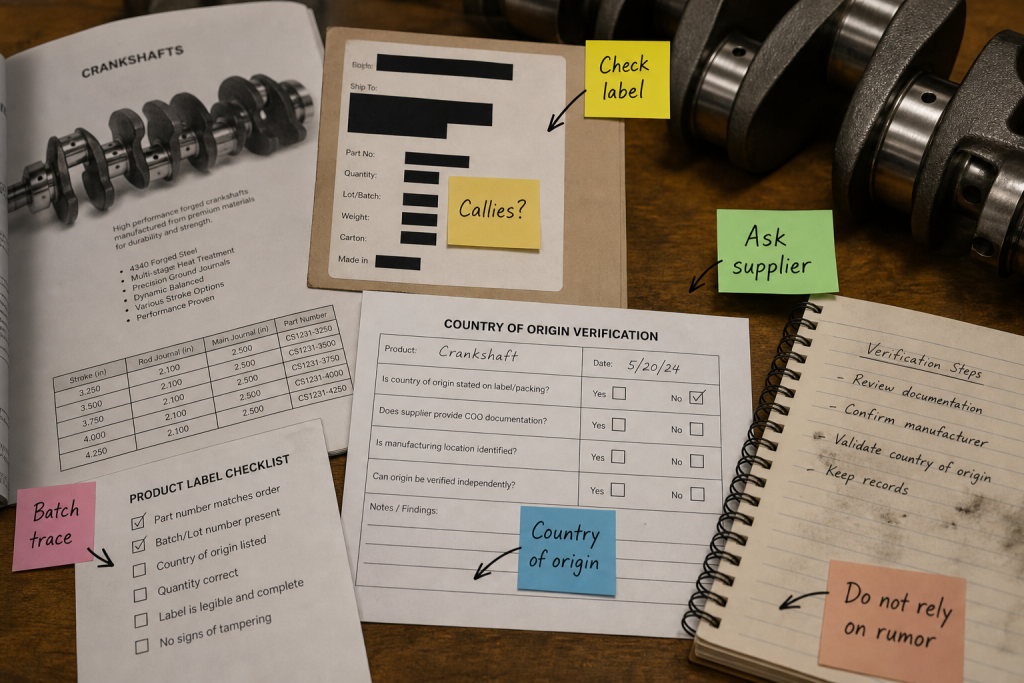
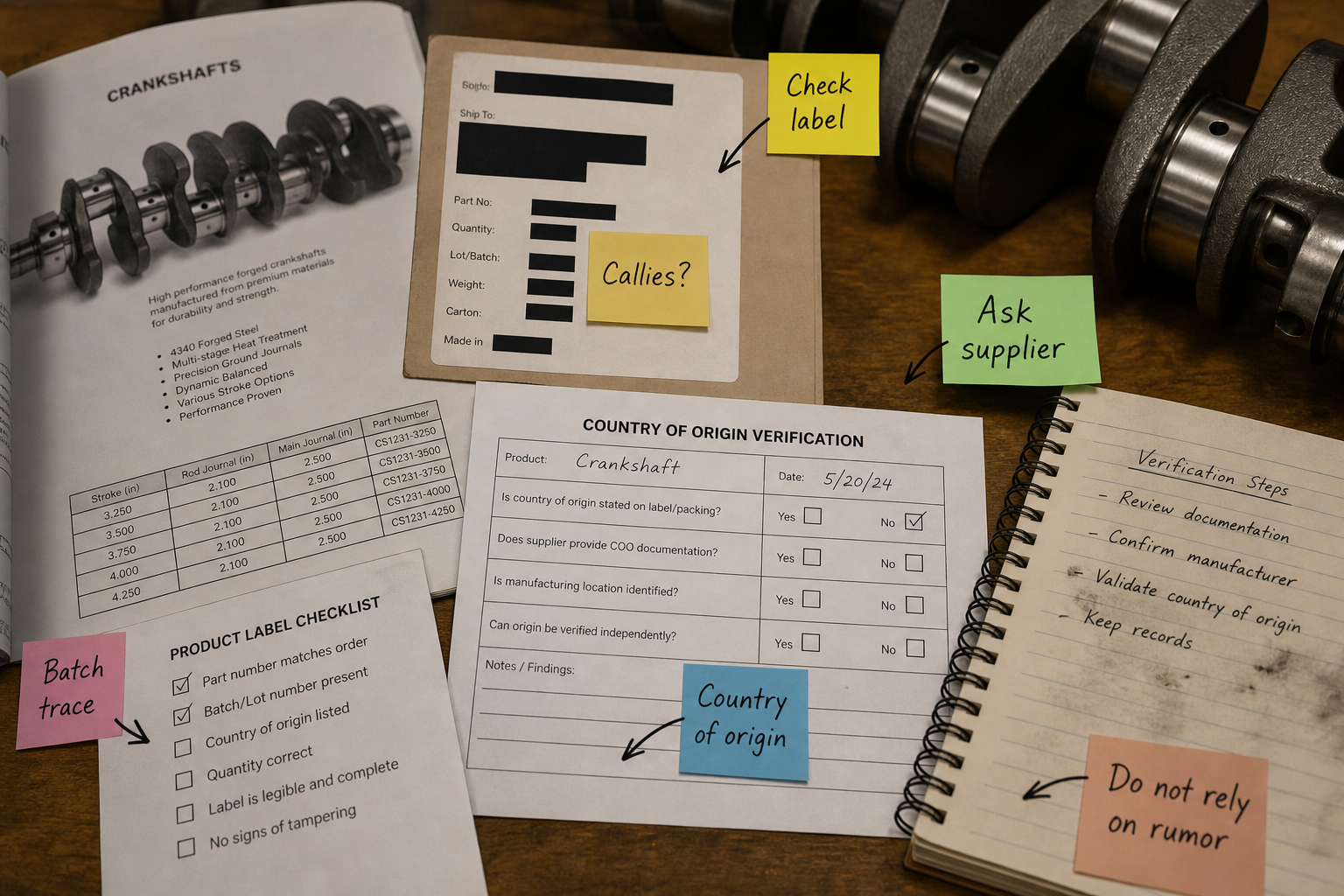
When you’re speccing a stroker motor and the machinist pulls a Callies crank from the shelf, the first question isn’t about stroke or journal size—it’s whether the part came from the original manufacturing facility or a contract shop halfway around the world. A builder comparing two identically labeled 4.000" stroke cranks needs to confirm production origin because heat-treat consistency, material traceability, and warranty coverage all hinge on where the forging or billet blank was actually machined and balanced.
Callies Performance Products manufactures crankshafts in the United States, with production facilities historically concentrated in Ohio. The company operates its own machining and heat-treatment operations for high-performance racing crankshafts, maintaining direct control over forging preparation, journal grinding, and final balancing rather than outsourcing critical operations to overseas contract manufacturers.
Key Takeaways
- Callies crankshafts originate from US-based manufacturing facilities with in-house machining and heat-treatment capability
- Part number prefixes, casting marks, and heat-treat stamps provide physical verification of production batch and facility origin
- Authorized distributor networks and direct factory confirmation offer the most reliable supplier verification method
- Counterfeit or misrepresented parts typically lack matching serial numbers, proper material certifications, and traceable batch documentation
- Manufacturing origin affects warranty coverage, material traceability, and replacement-part availability for engine builders
Brand Manufacturing History and Facility Location
Callies Performance Products established its manufacturing base in the United States during the late 1970s, focusing on drag racing and oval-track crankshaft applications where material integrity and dimensional precision directly determine engine survival at high RPM. The company chose vertical integration early, bringing forging preparation, CNC machining, nitriding, and dynamic balancing under one roof rather than relying on multiple subcontractors.
This manufacturing approach means most Callies crankshafts carry physical evidence of single-facility production. A forged piece starts as a rough forging blank, moves through preliminary machining, receives heat treatment in the same facility’s furnaces, then proceeds to final journal grinding and counterweight profiling before balancing.
Geographic concentration in Ohio positions the manufacturing operation near both raw material suppliers and the racing industry’s Midwest concentration. Engine builders in the drag racing and Pro Stock circuits often visit the facility directly for custom builds, creating a verification path that offshore manufacturing models cannot replicate.
Physical Manufacturing Clues on the Crankshaft
Every Callies crankshaft carries machined or cast markings that reveal production origin when you know how to read them. The part number is stamped on one counterweight, typically using a dot-matrix or laser-engraved format that’s difficult for counterfeiters to replicate with correct depth and font consistency.
Heat-treat batch codes appear as small alphanumeric stamps near the flange or on a counterweight surface. These codes link the crankshaft to a specific nitriding or tempering run, and Callies maintains batch records that match codes to production dates and material certifications. A genuine part’s batch code will decode to a real production date when verified with the factory.
Forging flash lines and parting seams tell you whether the starting blank came from a legitimate forging die. Callies forged cranks show consistent flash location and parting-line geometry across the same model family. Variations in flash pattern or evidence of casting porosity near parting lines indicate a different source forging, even if the finish machining looks correct.
Journal surface finish and fillet radii provide additional manufacturing fingerprints. Callies uses specific grinding-wheel specifications and CNC interpolation paths that produce characteristic surface patterns under 10× magnification. The fillet radii between journals and cheeks follow precise toolpath geometry; deviations suggest different machining equipment.
Supplier Verification Methods
Authorized Callies distributors maintain factory relationships that include direct product shipment, serial number registration, and warranty activation. When you purchase through these channels, the distributor can provide a serial number that matches factory shipping records, confirming the crankshaft left the US manufacturing facility for that specific order.
Direct factory verification works for custom or special-order cranks. Callies accepts serial number inquiries that match the stamped number on the part to production records, confirming manufacturing date, material specification, and original distributor. This check costs nothing and eliminates doubt about whether a used or surplus crankshaft originated from the legitimate facility.
Material certifications accompany new crankshafts when ordered through proper channels. These certificates document the steel alloy composition, heat-treat cycle parameters, and magnetic-particle inspection results. The certificate’s batch number must match the heat-treat stamp on the crankshaft itself; mismatches indicate the paperwork doesn’t belong to that specific part.
Third-party testing provides a fallback when documentation is missing. A metallurgical lab can section a counterweight, perform spectrographic analysis, and compare the alloy composition to published Callies material specifications. Hardness testing across the journal depth profile reveals whether nitriding or case-hardening matches the claimed process. These tests cost $200-500 but definitively answer origin questions when large money is at stake.
Common Manufacturing Origin Questions
Verification Method | Cost | Reliability | Typical Use Case |
Serial number factory check | Free | High | New or documented used cranks |
Material certification review | Free (if included) | High | New purchase verification |
Authorized distributor confirmation | Free | High | Initial purchase decision |
Metallurgical lab analysis | $200-500 | Very high | Suspected counterfeit or undocumented parts |
Visual inspection of markings | Free | Medium | Quick field assessment |
Distinguishing US Production from Contract Manufacturing
Some crankshaft brands split manufacturing between domestic finishing and offshore rough machining, creating confusion about actual origin. Callies maintains that both forging preparation and final machining occur in the US facility, but builders still encounter gray-market parts that claim Callies specifications without authorized production.
Contract-manufactured cranks often carry correct part numbers but lack matching serial numbers in factory databases. The stampings may look authentic at first glance, but dot-matrix depth, font kerning, and character alignment differ from genuine tooling. Counterfeiters struggle to replicate the exact stamping force and character spacing that automated factory equipment produces.
Material composition provides the definitive test. Callies specifies particular steel alloys with controlled chromium, molybdenum, and nickel content for different crankshaft models. A spectrographic test immediately reveals whether the actual alloy matches published specifications or whether a cheaper substitute was used. Heat-treat depth similarly exposes shortcuts; genuine nitrided Callies cranks show specific case depth profiles that surface hardening cannot fake.
Packaging and documentation consistency matters more than most builders realize. Genuine Callies cranks ship in specific box styles with matching labels, installation instructions, and warranty cards. The part number on the box, the stamped number on the crank, the serial on the warranty card, and the material cert batch code should all align. Inconsistencies between these elements suggest reassembly of parts from different sources.
What Manufacturing Location Affects
Warranty coverage depends entirely on verified manufacturing origin. Callies honors warranties for cranks purchased through authorized channels with traceable serial numbers, but gray-market or counterfeit parts receive no factory support regardless of claimed specifications. When a crankshaft fails at 8,000 RPM and destroys a $15,000 engine, warranty coverage makes the difference between a parts claim and total loss.
Material traceability affects liability in professional builds. Engine builders working on customer cars need documented proof that components meet specifications, especially for racing sanctions that require material certifications. A crankshaft without verifiable US manufacturing origin and proper material certs can disqualify an entire car from competition or void insurance coverage after a failure.
Replacement part availability changes based on production source. Callies maintains dimensional databases for every serial number produced, allowing exact replacement even years later if a used crank needs a different stroke or journal size. Contract-manufactured parts lack this manufacturing history, forcing builders to treat them as one-off custom pieces.
Resale value reflects manufacturing authenticity. A documented Callies crank with matching serial number and material cert maintains 60-70% of new value in the used racing market. An undocumented or suspected counterfeit piece drops to generic forged-crank pricing regardless of actual quality, because buyers cannot verify what they’re getting.
FAQs
Can you identify manufacturing origin from the part number alone?
The part number identifies the model and specifications but not the production facility or batch. You need the serial number stamp and heat-treat batch code to trace manufacturing origin. Part numbers can be copied; serial numbers in the factory database cannot.
Do all Callies crankshafts carry the same marking locations?
Marking locations vary by crankshaft family and production era, but each model uses consistent positions. Forged cranks typically stamp the part number on the first or second counterweight, while billet pieces may use the flange area. Heat-treat codes always appear in low-stress regions where stamping won’t create crack initiation sites.
How do you verify a used Callies crankshaft’s origin?
Contact Callies with the stamped serial number and request production verification. The factory will confirm whether that serial matches their records, the original production date, and the model specifications. If the serial doesn’t appear in factory databases, the crankshaft either predates their serial tracking system or didn’t originate from the legitimate facility.
What if the crankshaft has Callies markings but the distributor seems questionable?
Verify the serial number directly with Callies before purchase. Counterfeit parts often carry convincing stampings but use non-existent serial numbers. A five-minute factory check prevents buying a fake. Also request material certifications; legitimate distributors provide these automatically, while gray-market sellers cannot.
Does Callies ever outsource manufacturing to other countries?
Based on the company’s public statements and industry reputation, Callies maintains US-based manufacturing for its performance crankshaft lines. If outsourcing arrangements exist for specific product lines, they would be documented in product literature. When in doubt, ask directly about a specific part number’s manufacturing location before purchase.
Conclusion
Manufacturing origin verification protects both your engine investment and your professional reputation when building for customers or competition. The combination of serial number factory checks, material certification review, and physical inspection of stampings and machining quality gives you multiple verification layers that counterfeiters cannot replicate simultaneously. Before you trust a crankshaft’s claimed Callies origin, confirm the serial number traces to US production records and the material cert batch code matches the heat-treat stamp on the part itself.