
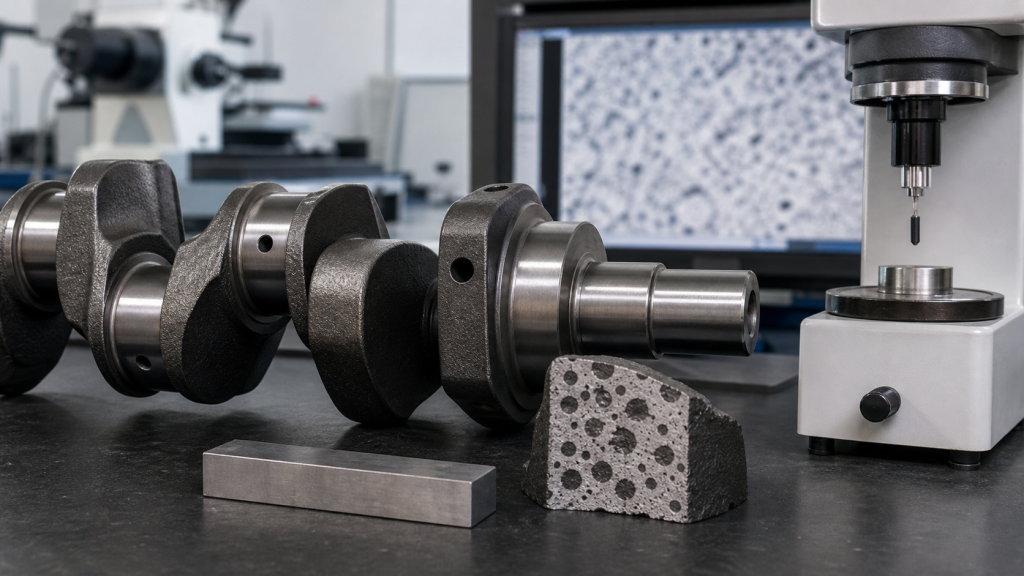
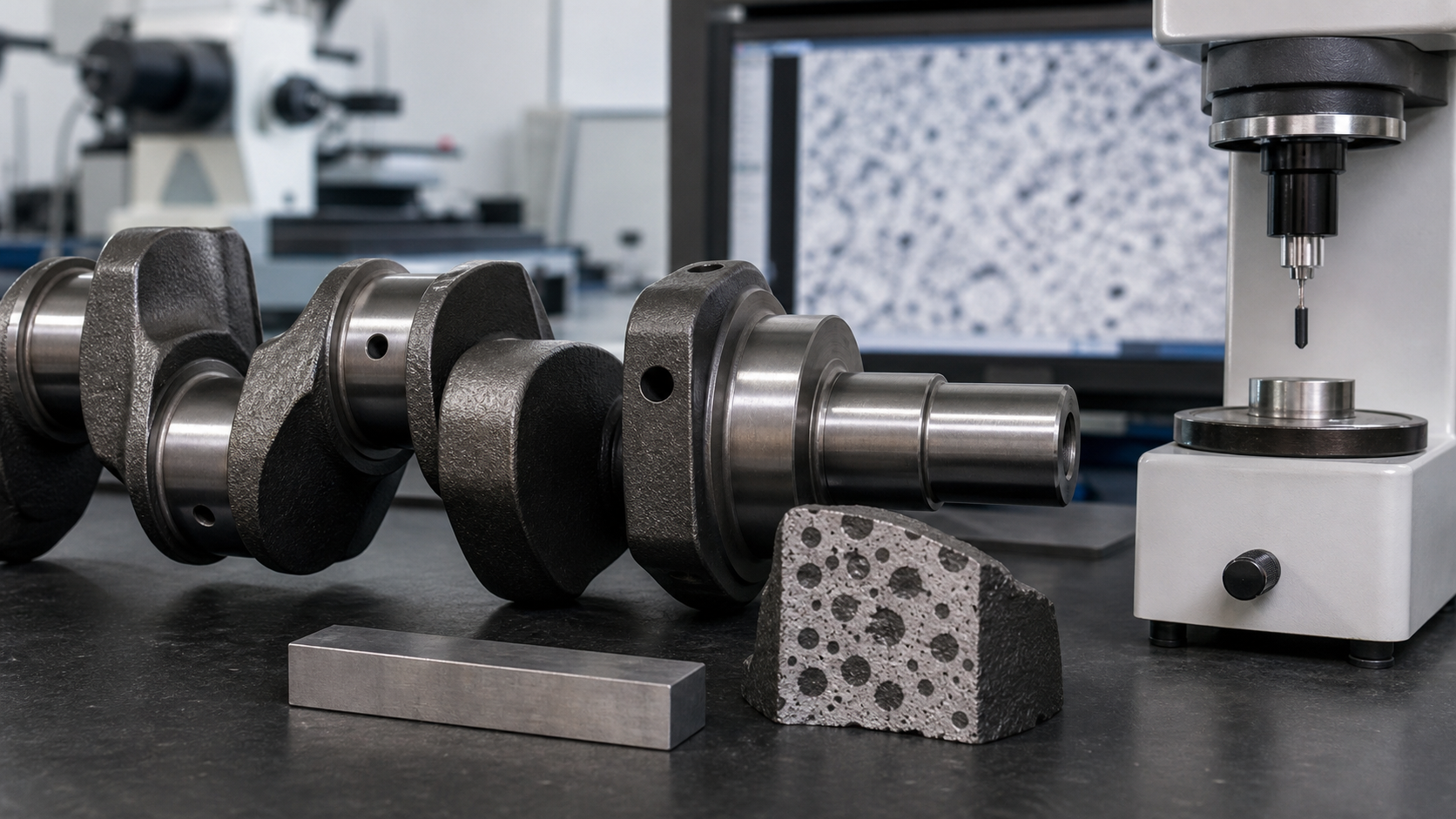
A crankshaft material specification means nothing without heat treatment records, dimensional inspection data, and grain-flow verification. Engine rebuilders who order "4340 steel" expecting automatic fatigue resistance discover too late that the certificate lists chemistry but omits the tempering temperature, hardness profile, and fillet radius that control crack initiation. Nodular iron castings can outlast forged steel when section modulus and stress concentration are correctly managed, while poorly executed forgings fail early despite premium alloy content.
Material selection depends on journal diameter, stroke length, peak cylinder pressure, production volume, and whether the crankshaft will be reground. The decision requires the engine maker’s drawing, measured runout and journal taper, failure history, and the manufacturing route—cast, forged from bar stock, or machined from billet. This article walks through nodular iron, carbon steel, alloy steel including 4340, and billet options, then provides a selection matrix conditioned on duty cycle and process capability.
Key Takeaways
- Material certificates prove chemistry but not heat treatment execution, grain flow, or fillet stress concentration—request hardness traverse data and process records before acceptance.
- Nodular iron castings offer lower cost and complex geometry but require larger section modulus to match forged-steel fatigue resistance in high-output diesel and performance gasoline engines.
- 4340 alloy steel provides high tensile strength and hardenability, yet crankshaft durability depends equally on forging direction, normalized microstructure, and final surface finish after grinding.
- Billet crankshafts eliminate forging-die cost for short runs but sacrifice the favorable grain flow that follows fillet contours in production forgings.
- Selection must reference peak firing pressure, journal diameter, bearing material, redline RPM, expected rebuild intervals, and whether the design allows regrinding within the maker’s minimum journal limit.
Material Grade Is Only One Part of Crankshaft Strength
Crankshaft strength emerges from the interaction of base material properties, heat treatment, section geometry, surface finish, and residual stress state. A forging in plain carbon steel can exceed the fatigue life of a poorly heat-treated alloy part when the carbon-steel piece receives correct normalizing, the fillet radius meets the drawing, and the final grind leaves compressive surface stress. Conversely, an alloy forging with decarburized surface layers, coarse grain structure, or sharp fillet transitions will crack at the oil hole or fillet root despite the alloy designation on the certificate.
Before comparing materials, define the loading condition. Peak cylinder pressure, connecting-rod angle at maximum torque, engine redline, and bearing span determine the bending moment and torsional stress at the crankpin and main journal fillets. Measure the existing crankshaft if replacing a failed part: record all journal diameters, runout on V-blocks, fillet radii with a radius gauge, and oil-passage diameter and location. Compare these measurements to the engine maker’s drawing or service manual. A journal worn beyond the maker’s minimum regrind limit requires a new crankshaft regardless of material.
Manufacturing route—cast, forged, or billet—determines grain structure and geometry flexibility. Cast crankshafts form the blank in one operation and allow complex counterweight shapes and integral balance weights. Forged crankshafts begin as bar stock, and the forging dies align grain flow along the high-stress fillet regions. Billet crankshafts start as a solid round or rectangular bar and rely entirely on machining, cutting across the bar’s longitudinal grain with no opportunity to shape flow lines around fillets. Each route suits different production volumes, lead times, and performance requirements.
Nodular Iron and Other Cast Routes
Nodular iron—also called ductile iron or spheroidal graphite iron—dominates production automotive and light-duty diesel crankshafts where cost and manufacturing rate matter more than ultimate weight reduction. The graphite nodules in the ferritic or pearlitic matrix provide damping, machinability, and enough ductility to resist brittle fracture, though tensile strength and fatigue endurance remain lower than forged steel.
Cast crankshafts use nodular iron grades selected for the application’s stress level. The casting process allows counterweights to be formed integrally, reducing the number of components and eliminating the need for separately attached weights. However, the as-cast surface requires additional machining on all bearing journals, and the section modulus must be larger than an equivalent forged-steel design to achieve the same fatigue margin.
Inspect a cast crankshaft for porosity, shrinkage cavities, and inclusions that compromise fatigue strength. Magnetic-particle or dye-penetrant inspection after rough machining reveals surface defects. The foundry’s process control—inoculant addition, mold temperature, cooling rate—directly affects nodule count, nodule shape, and matrix structure. Request the foundry’s inspection report, including nodule count per area, nodule roundness, and matrix ferrite-to-pearlite ratio if the application involves sustained high load or elevated temperature.
Cast steel crankshafts, less common than nodular iron, use plain carbon or low-alloy steel poured into sand or investment molds. They offer better fatigue resistance than nodular iron but cost more and still require significant post-cast machining. Cast steel suits medium-production volumes where forging-die cost is prohibitive but performance exceeds nodular-iron capability.
Forged Carbon and Alloy Steels
Forged crankshafts use carbon steel (1045, 1053) or alloy steel (4140, 4340, 5140) bar stock, heated and shaped in closed dies that align the grain structure along the crankpin and main journal axes. The forging operation work-hardens the material and creates favorable grain flow around fillets, improving fatigue resistance compared to machining through randomly oriented bar-stock grain.
Carbon steel forgings provide adequate strength for naturally aspirated gasoline engines and moderate-output diesels when the design includes sufficient section modulus and generous fillet radii. After forging, the part is normalized—heated to austenitizing temperature and air-cooled—to refine grain size and relieve forging stresses. Final heat treatment may include induction hardening of bearing journals while leaving the core softer for toughness.
Alloy steel forgings add chromium, molybdenum, nickel, or vanadium to increase hardenability, tensile strength, and high-temperature performance. The alloy content allows through-hardening of larger sections and supports higher peak cylinder pressures. Alloy forgings typically achieve higher tensile strength after quenching and tempering compared to plain carbon steel in the normalized condition.
Verify a forged crankshaft’s condition by measuring journal diameters, runout, and fillet radii, then compare to the engine maker’s drawing. Check the certificate for material specification, heat lot, and any heat treatment notation. If available, request a hardness traverse report showing surface and core hardness at the main journal, crankpin, and fillet regions. Surface hardness below the specified range indicates decarburization during forging or heat treatment; excessively high core hardness suggests insufficient tempering and brittle fracture risk.
Magnetic-particle inspection after final grinding reveals cracks at fillets, oil holes, or journal surfaces. Grinding burns—visible as dark, discolored patches—signal localized overheating that transforms surface martensite to softer, less fatigue-resistant structures. Reject any crankshaft with visible grinding burns, cracks, or journal taper exceeding the engine maker’s service limit.
Where 4340 Steel Fits and What the Name Does Not Prove
4340 alloy steel appears in racing, marine, and heavy-duty diesel crankshafts because its nickel-chromium-molybdenum composition supports deep hardening, high tensile strength, and good impact toughness. However, specifying "4340" on a purchase order does not by itself ensure a fatigue-resistant crankshaft. Heat treatment execution, grain size, surface finish, and residual stress state dominate durability.
A 4340 forging must be austenitized, oil-quenched, then tempered depending on the target hardness. Insufficient quench rate in thick sections leaves a mixed microstructure with lower strength and toughness. Over-tempering reduces hardness below the required range; under-tempering leaves brittle untempered martensite. Request the heat treater’s furnace chart, quench-time log, and tempering-temperature record. A certificate listing only the material specification without processing details provides no assurance of mechanical properties.
Grain flow matters as much as alloy content. A billet 4340 crankshaft machined from round bar cuts through the bar’s longitudinal grain, leaving grain boundaries perpendicular to the fillet stress and reducing fatigue strength. A forged 4340 part with proper die design aligns grain around the fillet radius, increasing crack-initiation resistance. For short production runs or custom builds, the billet route avoids forging-die cost, but the design must compensate with larger fillet radii, lower stress concentration factors, and potentially oversize journals.
Surface finish directly affects fatigue life. Grinding marks, tool chatter, or nicks concentrate stress and initiate cracks. The engine maker’s drawing specifies maximum surface roughness on bearing journals and fillets. Polishing or shot peening after grinding introduces compressive residual stress at the surface, delaying crack nucleation. Many high-performance crankshafts receive nitriding—diffusion of nitrogen into the surface layer—to increase hardness and wear resistance without the distortion risk of through-hardening.
4340 steel will not save a crankshaft with inadequate fillet radius, mislocated oil holes, or bearing journals ground undersize beyond the maker’s regrind limit. The material enables higher stress capability, but geometry and process must support it. When a 4340 crankshaft fails in service, measure the fillet radius, check oil-hole edge breaks, verify bearing clearance, and confirm that the engine did not exceed the redline or suffer lubrication starvation before concluding that the material itself was at fault.
Billet Stock, Grain Flow, Heat Treatment, and Fatigue
Billet crankshafts are machined from solid bar stock—round, square, or rectangular—using CNC mills and lathes. The process suits low-volume production, rapid prototyping, and engines where no forging dies exist. Materials include 4340, 300M (a higher-strength variant of 4340), EN24T (British designation for 817M40, similar to 4340), and occasionally stainless steels for marine or corrosive environments.
The primary trade-off is grain structure. Bar stock exhibits longitudinal grain from the rolling or extrusion process. Machining a crankshaft from billet cuts across this grain, leaving grain boundaries oriented perpendicular to the fillet stress field. Forged crankshafts, by contrast, use dies that flow the grain around the fillet contours, aligning the grain parallel to the stress direction and improving fatigue resistance in laboratory testing.
To compensate for unfavorable grain flow, billet crankshaft designs increase fillet radii, reduce stress concentration factors, and may specify shot peening or nitriding. The designer must also ensure that the bar stock’s center—where impurities and inclusions segregate during billet casting—does not coincide with high-stress regions like the crankpin or main journal. Bar stock certificates should include ultrasonic inspection results to confirm internal soundness.
Heat treatment for billet crankshafts follows the same quench-and-temper procedures as forgings but requires more careful distortion control since the part lacks the forging’s work-hardened structure. After rough machining, the crankshaft is heat treated, then finish-ground to final dimensions. Grinding after heat treatment removes any decarburized layer and corrects distortion from quenching, but it also removes some case depth if the part was carburized or nitrided before grinding. Coordinate heat treatment and final machining to ensure the specified surface hardness and core toughness remain after all operations.
Billet crankshafts cost more per part than production forgings because machining cycle time is longer and material utilization is lower. However, the absence of die cost makes billet competitive for short runs, custom racing engines, or prototype development where the design may change before production tooling is justified. Refer to the billet crankshaft guide for detailed process and application discussion.
Material Selection Matrix by Duty and Production Route
Material selection begins with engine type, peak cylinder pressure, redline RPM, and production volume. The table below maps common applications to suitable material and manufacturing combinations. Actual selection requires the engine maker’s drawing, measured crankshaft geometry, and failure history if replacing a broken part.
Application | Typical Material | Manufacturing Route | Key Validation |
|---|---|---|---|
Passenger car gasoline, naturally aspirated | Nodular iron | Cast | Nodule count, porosity inspection, journal runout per specification |
Light-duty diesel, naturally aspirated | Nodular iron (higher grade) or forged carbon steel | Cast or forged | Hardness traverse at core and surface, fillet radius per drawing |
Turbocharged gasoline or diesel | Forged alloy steel (4140 or 4340) | Forged from bar | Magnetic-particle inspection after grind, surface finish per specification |
Racing gasoline, high RPM | Forged or billet 4340 | Forged or billet | Nitriding or shot peening, counterweight balance per maker’s tolerance |
Heavy-duty diesel, marine, industrial | Forged 4340 or EN24T | Forged from bar | Ultrasonic inspection, oil-hole chamfer verification, journal taper per specification |
Custom or prototype, low volume | Billet 4340 or 300M | CNC machined from bar | Bar stock ultrasonic inspection, post-machining stress relief, fillet radius larger than forged equivalent |
Use this matrix as a starting point, not a final specification. Confirm that the chosen material and route support the engine maker’s journal diameter, stroke, bearing span, and counterweight configuration. For replacement crankshafts, measure the old part’s journals and compare to the maker’s minimum regrind limit. If journals are already at minimum, a new crankshaft is required regardless of material upgrade.
Production volume affects route selection. Forging dies require significant initial investment, making forgings economical above certain production quantities. Cast tooling costs less but requires higher per-part volume to justify pattern and core-box investment. Billet machining has no tooling cost but higher per-part expense, making it viable for short runs or when the design is not final.
Consult a crankshaft manufacturer for specific material recommendations conditioned on your engine model, operating duty, and available drawings. For additional context on production methods, see how crankshafts are manufactured and automobile crankshaft manufacturing process.
FAQs
Can I upgrade a cast-iron crankshaft to forged steel in the same engine?
Only if the forged replacement matches the original’s journal diameters, stroke, counterweight positions, and bolt-hole pattern. Switching materials without verifying dimensional compatibility can cause bearing misalignment, vibration, or interference with the block. Measure the original crankshaft and compare to the replacement’s drawing before installation.
Does 4340 steel require special machining or grinding equipment?
4340’s higher hardness in the quenched and tempered condition requires CBN (cubic boron nitride) or aluminum-oxide grinding wheels and slower feed rates compared to plain carbon steel. Standard carbide tooling handles rough machining before heat treatment, but post-heat-treatment operations need grinding rather than turning. Communicate material hardness to the machine shop before quoting regrind or repair work.
How do I verify that a crankshaft was actually forged rather than machined from billet?
Examine the parting line—forged parts show a faint line where the two die halves met. Billet-machined crankshafts have no parting line and may show CNC tool-path marks. If accessible, magnetic-particle inspection after etching with nital solution reveals grain flow; forged parts show continuous flow lines around fillets, while billet parts show grain running parallel to the bar axis and cut by the machined fillet. Request the manufacturer’s process documentation if verification is critical.
What surface finish is acceptable on a reground crankshaft journal?
The engine maker’s service manual specifies maximum roughness for bearing journals. Measure with a profilometer after regrinding. Visible grinding marks, chatter, or discoloration indicate poor grinding practice and risk premature bearing wear or journal cracking. Reject any journal with grinding burns or surface roughness exceeding the specification. Refer to the crankshaft repair decision guide for detailed regrind criteria.
Does nodular iron require different balancing procedures than forged steel?
Balancing procedure depends on counterweight configuration and engine design, not material. However, nodular iron’s lower modulus of elasticity compared to steel means the crankshaft deflects more under load, potentially affecting dynamic balance at high RPM. For high-redline engines, verify that the balance tolerance matches the engine maker’s specification and that the balancing machine’s correction planes align with the crankshaft’s counterweights.
Conclusion
Crankshaft material selection requires more than choosing a grade from a list. Nodular iron suits cost-sensitive, moderate-load applications when section modulus compensates for lower fatigue strength. Forged carbon and alloy steels provide higher performance but depend on correct heat treatment, grain flow, and surface finish. 4340 alloy steel enables the highest stress capability but does not eliminate the need for proper geometry, process control, and inspection. Billet stock trades favorable grain flow for tooling flexibility, requiring larger fillets and additional surface treatment.
Before specifying or ordering a crankshaft, gather the engine maker’s drawing, measure the existing part if available, and document the operating duty—peak cylinder pressure, RPM range, and expected service life. Request material certificates, heat treatment records, hardness traverse data, and dimensional inspection reports. Verify fillet radii, oil-hole location, bearing journal finish, and runout against the drawing limits. This documentation prevents wrong-part installation, premature failure, and wasted machining effort on crankshafts that cannot meet the application’s stress or geometry requirements.