
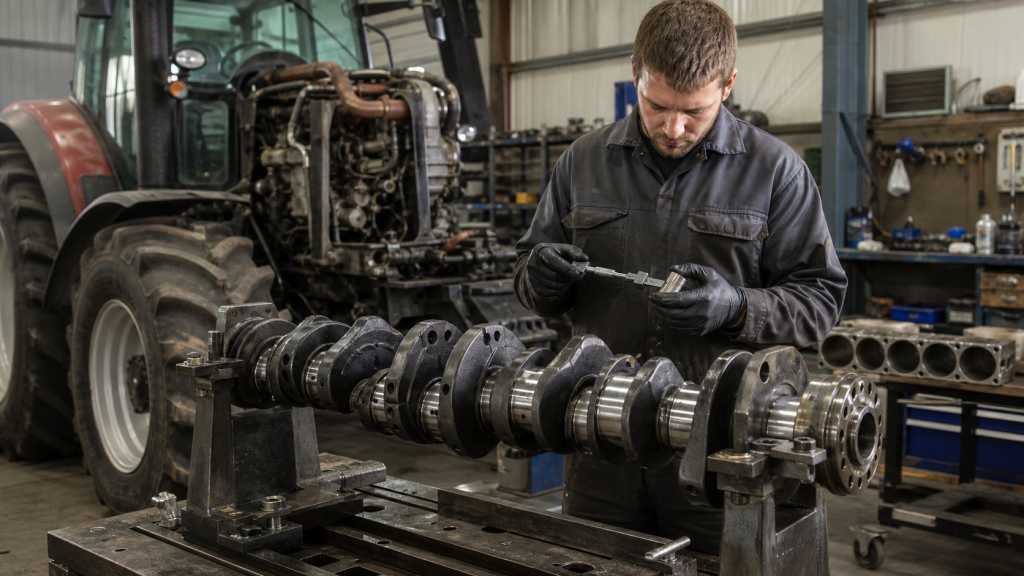
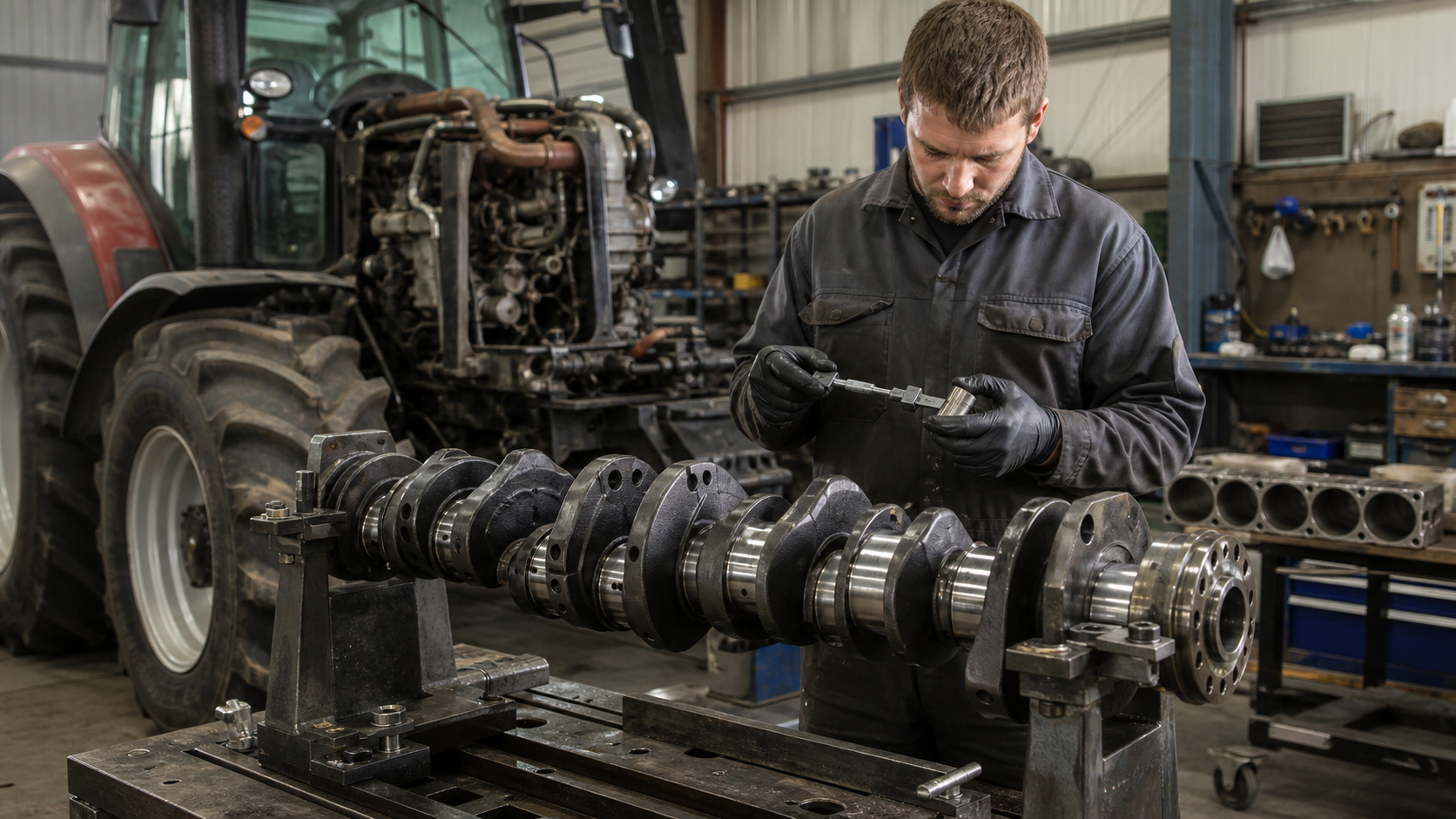
A combine crankshaft fracture during wheat harvest leaves a fleet owner facing a multi-day machine-shop backlog and lost weather windows. The technician finds a reground crankshaft listed online at half the OEM price, but the part number does not match the engine nameplate, the seller cannot confirm journal dimensions, and no one on site has measured the block saddle bores. Rushed sourcing decisions during peak field work often lead to mismatched replacements, additional machining delays, or repeat failures when the root cause was never diagnosed.
A tractor crankshaft converts reciprocating piston motion into rotary power under conditions that differ sharply from highway diesel or industrial stationary engines. Agricultural duty involves sustained high-load operation at relatively low engine speeds, extended idle periods in dusty environments, seasonal overload during planting or harvest, and deferred maintenance when field schedules override service intervals. Selecting the correct replacement requires matching the engine model designation to the crankshaft part number, measuring journal diameters and runout to confirm the failure mode, understanding whether forged or cast construction suits the duty cycle, and verifying that the supplier provides dimensional inspection data and material certifications traceable to the engine maker’s specifications.
Key Takeaways
- Tractor engines operate at sustained high torque and low RPM, placing maximum bending stress on crankshaft journals rather than high-cycle fatigue typical of automotive applications.
- Main journal and rod journal diameter measurements, fillet radius condition, and total indicated runout determine whether regrinding is feasible or a new crankshaft is required.
- Engine model codes and serial-number ranges control part-number interchange; a visually similar crankshaft may have different stroke, journal diameter, oil-passage configuration, or flywheel-flange bolt patterns.
- Common failure modes include journal scoring from oil starvation, fillet cracks from overload or torsional vibration, thrust-surface wear from clutch operation, and keyway damage from loose flywheel or PTO drive components.
- Forged crankshafts offer higher fatigue strength for heavy-duty or turbocharged applications, while cast crankshafts provide acceptable service life in naturally aspirated tractors when maintenance intervals are followed.
- Procurement checklists must include engine identification plate data, measured journal dimensions, failure-cause documentation, drawing or tolerance references, and supplier inspection records to prevent incorrect parts and repeat failures.
Why Tractor Duty Is Different from Light Road Use
Tractor engines spend most of their operating hours under load at moderate engine speeds, contrasting with on-highway engines that cycle frequently between idle and governed speed. This operating profile shifts the dominant crankshaft stress from high-cycle fatigue to sustained bending and torsional loads. Agricultural diesels may generate substantial torque for hours during tillage or baling, imposing steady bending stress on the main journals and deflecting the crankshaft within the block saddle clearances.
Dust ingestion past air-filter seals or through breather systems accelerates bearing wear, reducing oil-film thickness and allowing metal-to-metal contact at the journals. Extended idle periods during field pauses allow combustion byproducts and moisture to settle in the oil, promoting corrosion on thrust surfaces and in oil passages. Seasonal overload occurs when operators advance throttle settings or load implements beyond design limits to complete planting before rain or harvest before frost, increasing instantaneous bearing loads and torsional vibration.
Deferred oil changes, delayed bearing inspections, and skipped coolant-system maintenance are common when field schedules conflict with service intervals. Overheating from radiator blockage or failed thermostats reduces oil viscosity, lowers bearing load capacity, and can cause journal scoring within a single operating day. These combined factors mean that a tractor crankshaft may accumulate more severe wear in a given period of agricultural use than a highway engine experiences over significantly longer mileage in mixed driving conditions.
Failure Causes during High-Load, Low-Speed Field Work
Journal scoring appears as axial grooves on the main bearing or rod bearing surfaces, caused by oil starvation, abrasive contamination, or loss of bearing clearance. Agricultural engines often experience scoring after rapid coolant loss or radiator blockage raises oil temperature beyond safe limits, dropping viscosity and collapsing the hydrodynamic film. The depth of scoring determines whether regrinding can salvage the crankshaft or whether replacement is required. Refer to the engine maker’s regrind specifications for acceptable scoring limits.
Fillet cracks initiate at the radius transition between the journal and the crankshaft web, where bending stress concentrates during peak torque events. Magnetic-particle or dye-penetrant inspection reveals cracks as fine lines radiating from the fillet. Overload conditions such as stuck implements, hydrostatic drive lockup, or sudden clutch engagement during cold starts generate transient loads that exceed the fillet’s fatigue limit. Once a crack initiates, it propagates with each load cycle until catastrophic fracture occurs, often breaking the crankshaft into two pieces at a main journal.
Thrust-surface wear results from axial loads imposed by clutch operation, PTO engagement, or misaligned belt drives. The thrust faces on a designated main journal control crankshaft end play, limited by engine maker specifications. Wear beyond this range allows the crankshaft to shuttle axially, misaligning timing gears, damaging front and rear seals, and causing erratic clutch engagement. Thrust wear is measured with a dial indicator and pry bar; readings above specification require machining the thrust faces or replacing the crankshaft.
Keyway damage occurs when flywheel mounting bolts loosen or when a PTO drive key shears during overload. A loose flywheel rotates slightly relative to the crankshaft flange, elongating the keyway or peening the flange face. Crankshaft replacement becomes necessary when keyway width exceeds acceptable tolerance or when flange runout indicates permanent bend. Operators sometimes attempt field repairs by installing oversize keys or tack-welding the flywheel, which create stress risers and accelerate fatigue failure.
Measure Journals, Runout, Thrust Surfaces, and Cracks
Main journal and rod journal diameters must be measured with an outside micrometer at three locations around the circumference and at both ends of each journal. The crankshaft should be supported in V-blocks or on the end journals to avoid deflection during measurement. Record the minimum diameter found at each journal; significant differences between readings indicate out-of-round wear, and differences between the ends indicate taper.
Compare measured diameters to the engine maker’s service manual specifications. Each engine model defines acceptable wear limits based on the journal size and bearing design. If all journals are within tolerance and show no taper or out-of-round condition, the crankshaft may be reusable with new standard-size bearings. If journals are below tolerance but still have adequate material above the first undersize specification, regrinding is feasible.
Total indicated runout (TIR) is measured by placing the crankshaft on the end main journals in V-blocks or between centers, then mounting a dial indicator on the center main journal. Rotate the crankshaft slowly and record the maximum indicator deflection. Acceptable runout varies by crankshaft length and journal diameter. Most agricultural engine specifications provide a maximum TIR limit; runout above specification indicates a bent crankshaft, which cannot be corrected by regrinding alone and requires straightening or replacement.
Fillet radii must be inspected visually under magnification and with fillet gauges after cleaning all journals with solvent and compressed air. A fillet radius that is too sharp, below the design specification, or showing visible cracks disqualifies the crankshaft for regrinding. Regrinding reduces the journal diameter but must maintain or increase the fillet radius to avoid creating a stress concentration. Consult the engine maker’s specifications for minimum acceptable fillet dimensions.
Thrust-surface wear is measured by installing the crankshaft in the block with main bearings, then using a pry bar to move the crankshaft fully forward and rearward while monitoring end play with a dial indicator. The indicator tip should contact the crankshaft flange or a thrust collar. Measured end play is compared to the engine maker’s specification. Excessive end play requires machining the thrust faces or replacing the crankshaft if insufficient material remains.
Magnetic-particle inspection detects cracks in ferrous crankshafts by applying a magnetic field, coating the surface with iron-oxide particles, and observing particle accumulation at crack locations under ultraviolet light. Dye-penetrant inspection is used for non-magnetic materials or when magnetic equipment is unavailable. Any crack indication in a main journal fillet, rod journal fillet, or oil passage disqualifies the crankshaft for continued service. Surface scratches and tool marks may create false indications; trained inspectors distinguish these from structural cracks by depth, orientation, and particle pattern.
Confirm Engine Code and Part Interchange before Ordering
Tractor engine identification plates or stampings on the block provide the model code, serial number, and sometimes the build date. This information controls which crankshaft part numbers are compatible. Engine families may share bore and stroke dimensions but differ in crankshaft design due to balance-weight configuration, oil-passage location, flywheel-flange bolt pattern, or front pulley hub dimensions. A crankshaft that physically fits the block may not align the timing marks, may require different main bearing widths, or may lack the rear seal surface machining required by the engine’s seal design.
Part-number cross-reference requires access to the engine maker’s parts catalog or an aftermarket interchange database. Many agricultural engine families underwent revisions across production years, changing crankshaft specifications mid-series. For example, a turbocharged version of a naturally aspirated engine may use a forged crankshaft with larger fillet radii and different balance weights, even though the block and stroke remain identical. Installing the wrong crankshaft can cause vibration, seal leakage, or bearing failure even if the engine initially runs.
Dimensional drawings or factory specifications confirm journal diameters, stroke length, overall length, and critical interface dimensions. A replacement crankshaft should match these dimensions within the tolerances specified by the engine maker. The stroke dimension, defined as twice the throw distance from the main journal centerline to the rod journal centerline, directly affects piston travel and compression ratio. An incorrect stroke changes engine displacement and may cause piston-to-valve or piston-to-head interference.
Bearing-journal widths must match the engine’s main bearing and rod bearing sizes. Agricultural crankshafts often use narrower main bearings in the front journals and wider bearings at the rear or center thrust location. A crankshaft from a related engine model may have the correct journal diameter but different bearing widths, preventing proper bearing retention or causing side clearance issues.
Oil-passage configurations vary by engine design. Some agricultural crankshafts use drilled passages from the main journals to the rod journals, while others use cast passages or external oil lines. The passage exit location on the rod journal must align with the bearing oil hole to ensure connecting-rod lubrication. A crankshaft with passages drilled at the wrong angle will starve the rod bearings, causing rapid failure.
Flywheel-flange bolt patterns and pilot-bearing bores differ among engine families. Even when the crankshaft stroke and journals match, an incorrect flange prevents flywheel installation or causes misalignment with the clutch or torque converter. The pilot bearing or bushing bore diameter at the rear of the crankshaft must match the transmission input shaft; a mismatch prevents the shaft from centering, causing input-shaft bearing failure or clutch chatter.
New, Reground, or Used Replacement Decision
A new crankshaft from the engine manufacturer or a qualified aftermarket supplier avoids relying on the remaining fatigue life of a used component. For high-value engines, turbocharged applications, or failures involving a suspected material defect, ask the supplier what material certificates, dimensional inspection records, traceability, and warranty coverage are included. Compare those documented terms with the measured condition and machining requirements of a repairable crankshaft instead of assuming every new part carries the same evidence package.
Regrinding restores a worn or scored crankshaft by machining the journals to a smaller diameter, typically available in incremental undersize steps. The crankshaft must pass inspection for cracks, excessive runout, and adequate remaining material before regrinding. The machine shop grinds the journals concentric, polishes the fillet radii to remove stress risers, and provides a dimensional report showing final diameters, taper, and out-of-round. Undersize bearings are available for most agricultural engines in standard undersize increments specified by the engine maker.
Regrinding is not feasible when the crankshaft has cracks, when journals have already been reground to the last available undersize, when the fillet radii are worn or damaged, or when runout exceeds the machine shop’s straightening capability. Some agricultural crankshafts have induction-hardened journals; regrinding removes the hardened layer and exposes softer core material, reducing service life. The engine maker’s service manual specifies whether hardened journals can be reground and what minimum hardness must be maintained after grinding.
Used crankshafts from salvage or exchange programs offer lower initial cost but carry unknown service history and remaining life. A used crankshaft should be inspected with the same rigor as a reground unit, including dimensional measurement, crack inspection, and runout verification. The supplier should provide a written inspection report and disclose any previous regrinding. Used crankshafts without documentation are suitable only for temporary field repairs or low-value engines where replacement is planned within a short operating period.
Exchange programs accept the failed crankshaft as a core and supply a reground unit, reducing net cost and ensuring that the replacement meets dimensional specifications. Reputable exchange suppliers inspect returned cores for cracks and excessive wear, discard unserviceable units, and regrind acceptable cores to standard undersize dimensions. Exchange programs work best when the core crankshaft can be returned promptly; delayed core returns may incur penalties or void the exchange pricing.
Understanding Crankshaft Manufacturing Methods
The manufacturing process directly affects crankshaft durability and suitability for agricultural duty cycles. Forged crankshafts begin as heated steel billets shaped under high pressure, aligning the metal grain structure along stress lines and creating superior fatigue resistance. Cast crankshafts are poured into molds and offer adequate strength for naturally aspirated engines when maintenance intervals are followed. Some manufacturers use nodular iron casting, which provides improved fatigue life compared to conventional gray iron while maintaining cost advantages over forging.
Forged units excel in turbocharged applications, high-hour commercial operations, and engines subjected to frequent overload. Cast crankshafts serve reliably in standard-duty tractors with consistent maintenance. When replacing a failed crankshaft, match or exceed the original construction method unless duty requirements have changed. Upgrading from cast to forged construction requires confirming that balance weights, flywheel specifications, and connecting-rod weights remain compatible.
Learn more about crankshaft manufacturing processes to understand how production methods affect service life and application suitability.
Tractor Crankshaft Procurement Checklist for Peak-Season Repairs
Before requesting quotes or placing orders, gather the following information to ensure the replacement crankshaft matches the engine and duty requirements:
Engine identification: Record the engine model code, serial number, and any nameplate designation from the engine block or rocker cover. Photograph the identification plate and include the image with the parts request.
Failed crankshaft measurements: Measure and record the main journal diameters, rod journal diameters, stroke length, and overall length of the removed crankshaft. Note any existing undersize markings or stamps on the counterweights. Document visible damage with photographs showing the failure location and type.
Bearing measurements: Measure the main bearing inside diameters and widths, rod bearing inside diameters, and bearing crush thickness. These dimensions confirm whether the failed crankshaft was standard size or had been previously reground to an undersize.
Failure cause documentation: Describe the operating conditions at failure, any preceding symptoms such as oil-pressure loss or unusual vibration, and the maintenance history including the last oil change and bearing inspection. This information helps the supplier recommend whether a standard replacement is adequate or whether upgraded materials or tighter tolerances are needed.
Drawing or specification reference: If available, provide the engine maker’s parts manual page showing the crankshaft part number, dimensional specifications, and material callout. This eliminates interchange questions and ensures the supplier quotes the correct part.
Material and construction preference: Specify whether a forged or cast crankshaft is required based on the engine’s duty cycle and whether the original was forged or cast. For turbocharged or high-hour applications, request forged construction even if the original was cast.
Lead time and shipping: State the required delivery date and whether expedited shipping is justified by downtime costs. Peak-season repairs often justify expedited freight when machine shop lead time or parts availability threatens harvest or planting schedules.
Inspection and certification requirements: Request a dimensional inspection report showing as-manufactured journal diameters, runout, and fillet radii. For critical applications, request material certifications showing chemistry and hardness. Confirm that the supplier’s quality system includes crack inspection and that rejected cores are not sold as serviceable parts.
Warranty and return terms: Clarify the warranty period, what failure modes are covered, and whether the warranty includes labor costs for a second teardown. Understand the return policy if the crankshaft does not fit or if dimensional errors are discovered during installation.
FAQs
Can a crankshaft be straightened if runout exceeds specification?
Straightening is possible for crankshafts with moderate runout, depending on the material and the straightening equipment available. The process involves supporting the crankshaft at the end journals, measuring the bend location, applying controlled force at that location, and repeatedly checking runout until it falls within tolerance. Straightening success depends on whether the bend is elastic or whether the material has yielded. Crankshafts with cracks, previous straightening attempts, or induction-hardened journals should not be straightened due to fracture risk. After straightening, magnetic-particle inspection must be repeated to verify that no new cracks have formed. Always consult the engine maker’s service procedures before attempting to straighten a crankshaft, as some designs explicitly prohibit this practice.
How many times can a crankshaft be reground before replacement is required?
The number of regrinding steps depends on the available undersize bearing range and the material remaining above the core or oil passages. The engine maker’s service manual specifies the maximum undersize and the minimum journal diameter allowed. Crankshafts with induction-hardened journals may be limited to fewer regrinding steps because removing the hardened layer exposes softer material. Each regrinding operation removes material to restore the journal to a smooth, concentric surface; once the minimum diameter is reached or undersize bearings are no longer available, replacement becomes necessary. Some engine families offer undersize bearings in multiple steps, while others have limited availability.
What causes oil passages to become blocked in agricultural crankshafts?
Oil passages block when sludge accumulates from extended oil-change intervals, when metal particles from bearing wear enter the oil system, or when casting sand or machining debris was not fully cleaned during manufacturing. Blocked passages starve downstream bearings of lubrication, causing rapid scoring and seizure. Cleaning blocked passages requires removing the crankshaft, flushing the passages with solvent under pressure, and verifying flow with compressed air. Some crankshafts have pressed-in plugs at the passage ends; these must be removed for cleaning and replaced with new plugs after flushing. If passages are blocked by hard carbon deposits that resist solvent cleaning, the crankshaft should be replaced rather than risking incomplete cleaning and subsequent bearing failure.
Are forged and cast crankshafts interchangeable in the same engine?
Forged and cast crankshafts are not directly interchangeable even when the stroke and journal dimensions match. Forged crankshafts have different balance-weight mass distribution, requiring a different flywheel or external balancing procedure. The connecting rods and pistons may also have different weights to match the crankshaft’s balance factor. Installing a forged crankshaft in place of a cast unit, or vice versa, without rebalancing the rotating assembly will cause vibration and accelerated bearing wear. Some engine families offer both forged and cast crankshafts as factory options; in these cases, the engine maker’s parts manual specifies whether the two types are interchangeable and what additional components must be changed.
What documentation should a machine shop provide after regrinding a crankshaft?
A complete regrinding report includes the main journal and rod journal diameters measured at multiple locations to confirm concentricity and absence of taper, the runout measured before and after grinding, the fillet radius dimensions or gauge verification, the grinding-wheel specification and final surface finish, and a statement that magnetic-particle or dye-penetrant inspection was performed after grinding with no cracks found. The report should also note any journals that required multiple grinding passes to remove scoring and should disclose the remaining material available for future regrinding. Photographs of the finished journals and fillets provide visual evidence of quality. The machine shop’s certification or quality-system registration gives additional confidence that procedures were followed. Request this documentation before accepting the reground crankshaft, as it becomes critical evidence if premature failure occurs.
Conclusion
Tractor crankshaft replacement decisions depend on accurate engine identification, measured journal dimensions, documented failure cause, and verified supplier capability to provide a dimensionally correct part with traceable inspection records. Rushed sourcing during peak field work amplifies the cost of a mismatch; confirming part numbers, measuring bearing clearances, and reviewing inspection reports before ordering prevents repeat teardowns and extended downtime. The next step is to measure the removed crankshaft’s journal diameters and runout, photograph the failure location and engine identification plate, and request a dimensional drawing or specification sheet from the supplier before committing to new, reground, or exchange options. For technical guidance on crankshaft inspection and repair procedures, visit the Auge Cranks homepage for additional resources.