
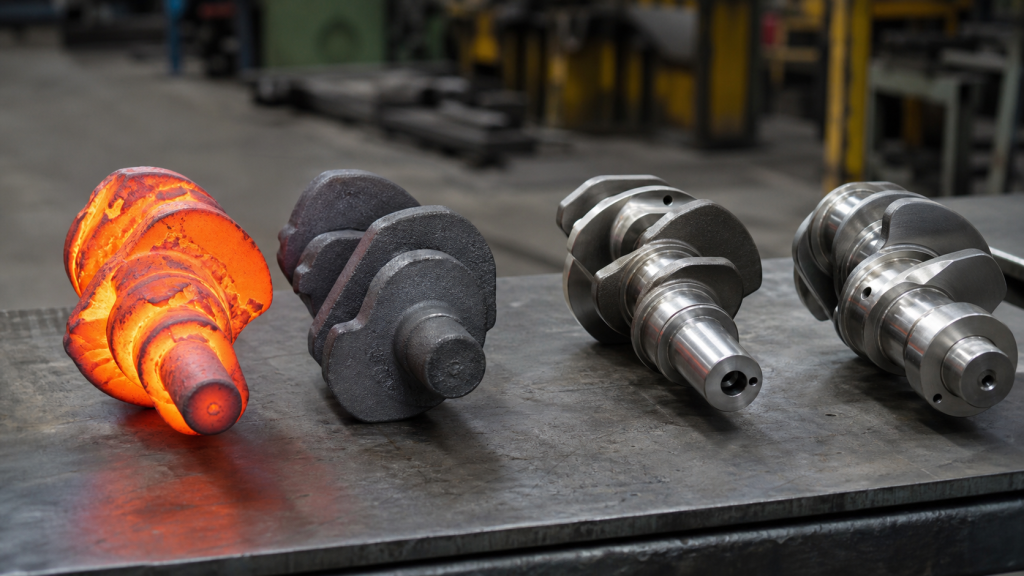
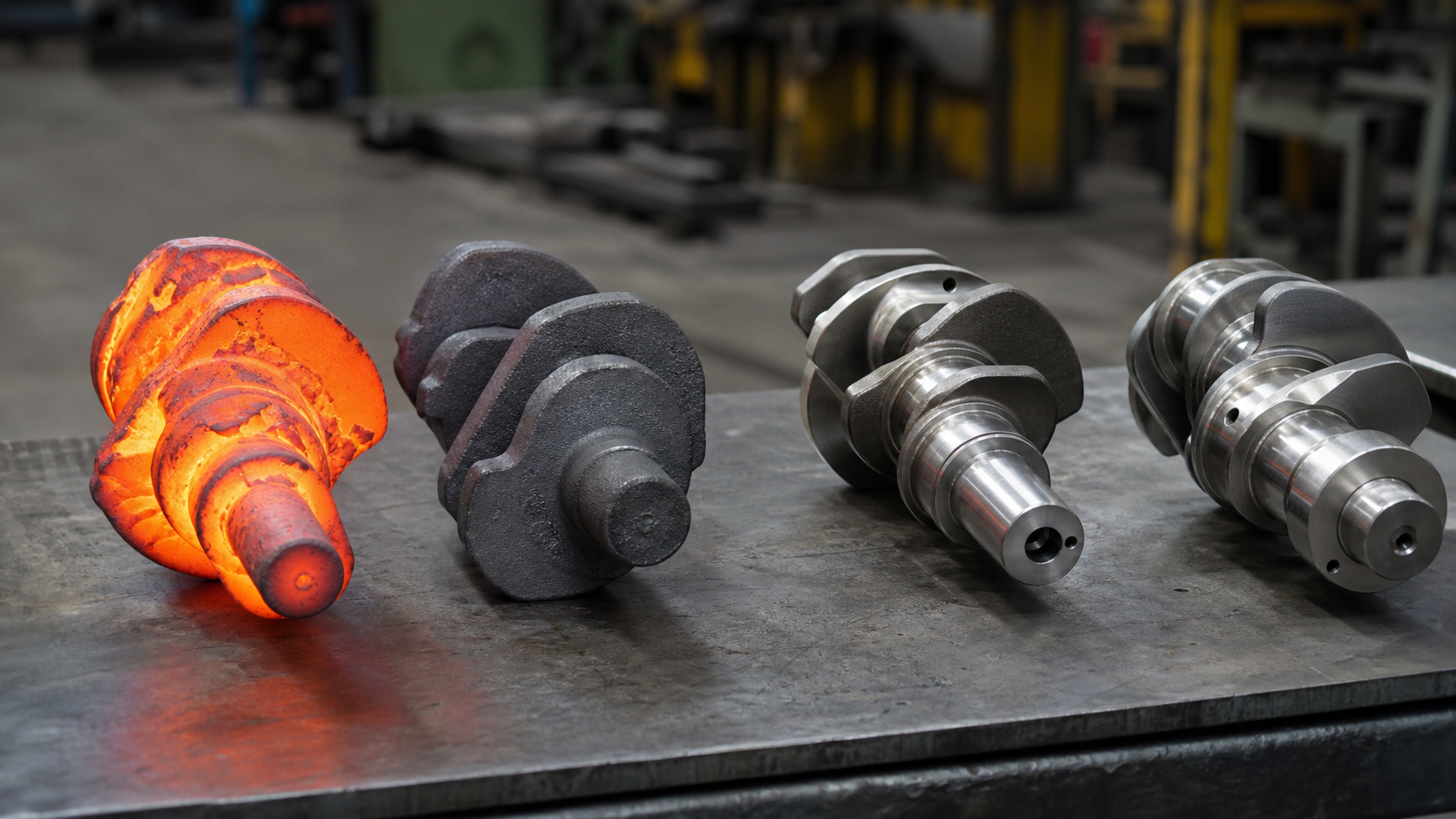
A diesel engine and a performance gasoline engine with similar displacement may share comparable bore, stroke, and journal dimensions, yet the diesel runs continuous high-torque duty at low speed while the gasoline engine sees high-RPM transient loads with frequent redline excursions. The diesel typically receives a cast iron crankshaft with nodular microstructure and induction-hardened journals; the gasoline performance engine demands a forged steel crankshaft with aligned grain flow and nitrided fillets. Same size, different duty, different process.
The forged vs cast crankshaft decision turns on load spectrum, production volume, and allowable cost rather than a universal strength ranking. Forging aligns metal flow with principal stress paths and tolerates impact better than casting, but casting offers lower tooling cost, simpler geometry flexibility, and adequate fatigue life for steady-load applications. Engineers select the process that matches the engine’s measured duty cycle and failure risk, not the one that sounds stronger.
Key Takeaways
- Forged crankshafts use hot or warm working to align grain flow with load paths, offering superior fatigue resistance under alternating stress and better impact tolerance in high-RPM or transient-load engines.
- Cast crankshafts solidify in a mold, producing isotropic properties and lower tool costs; nodular cast iron provides adequate fatigue life for continuous, moderate-load duty in diesel and truck engines.
- Fatigue life depends on fillet radius, surface finish, residual stress from heat treatment, and the relationship between operating stress amplitude and the material’s endurance limit.
- Machining and volume economics favor casting for complex counterweight shapes and lower-volume production; forging requires dedicated dies but scales efficiently at higher volumes.
- Selection criteria include engine power density, redline RPM, duty cycle (continuous vs. intermittent), expected overhaul interval, and allowable first-cost premium.
- Inspection priority shifts from dimensional runout and journal surface finish in cast crankshafts to fillet integrity and grain-flow verification in forged components.
The Short Rule: Match the Process to the Load Spectrum
A crankshaft sees fully reversed bending stress at every journal and torsional stress proportional to torque. The stress amplitude at the fillet—the transition between journal and counterweight—determines fatigue life. When the operating stress stays below the material’s endurance limit and the load profile is steady, a cast crankshaft with properly designed fillets and induction-hardened journals meets the requirement. When stress approaches or exceeds the endurance limit, or when the load includes shock or transient peaks, forged steel with aligned grain flow and compressive residual stress from nitriding becomes necessary.
Production diesel engines operating at moderate continuous RPM with torque curves peaking at low to mid-range typically use nodular cast iron crankshafts. The continuous load creates predictable stress cycles, and the controlled RPM limit keeps inertial loads manageable. Gasoline engines designed for high redlines and frequent wide-open-throttle acceleration use forged steel to survive the higher stress amplitude and occasional over-rev events. The same decision logic applies to rebuilds and replacements: verify the engine’s actual duty, then match the crankshaft process and material to that duty rather than assuming forged is always superior.
How Casting Solidifies and How Forging Directs Metal Flow
Casting pours molten metal into a sand or permanent mold shaped to the crankshaft’s final geometry. As the metal cools from the liquidus temperature, dendrites nucleate and grow, forming a polycrystalline structure with random grain orientation. Nodular cast iron adds magnesium to the melt, causing graphite to precipitate as spheroids rather than flakes; this microstructure transformation significantly improves both tensile strength and fatigue resistance compared to gray iron. The cast crankshaft emerges near-net-shape, requiring only journal grinding and oil-passage drilling.
Forging starts with a cylindrical steel billet heated to forging temperature, then progressively shaped in closed dies under substantial force. The metal flows plastically, and the original grain structure elongates along the flow direction. In a properly designed forging, the grain flow follows the journal centerline through the main and rod journals, then curves through the fillets into the counterweights. This aligned structure raises the fatigue strength perpendicular to grain flow compared to the same steel in a machined-from-billet condition. The forging requires subsequent machining to reach final journal tolerances, fillet radii, and oil-passage locations.
The key difference is isotropy versus anisotropy. Cast iron exhibits similar properties in all directions because the grains are randomly oriented; forged steel is strongest along the grain flow and somewhat weaker across it. For crankshafts, the principal stress direction at the fillet is perpendicular to the journal axis, which aligns well with the grain flow from a competent forging die design. This directional strength advantage matters most when stress amplitude is high or when impact loads could nucleate cracks.
Fatigue, Impact, Stiffness, Wear, and Heat-Treatment Differences
Fatigue life under fully reversed bending follows an inverse power-law relationship where cycles to failure depend on the ratio of the material’s endurance limit to the applied stress amplitude, raised to a material-specific exponent. A modest increase in applied stress amplitude can reduce fatigue life by a large factor. The endurance limits for induction-hardened nodular cast iron and nitrided forged steel differ significantly; consult material specifications and the engine manufacturer’s engineering data for the values applicable to your application.
Surface finish and residual stress dominate the practical fatigue limit. Grinding leaves tensile residual stress that lowers the effective endurance limit; nitriding or shot-peening introduces compressive residual stress that raises it. A forged crankshaft with ground but not-nitrided fillets may perform worse than a cast crankshaft with induction-hardened journals and properly radiused fillets. The process choice matters less than the final surface condition.
Impact resistance distinguishes forged steel most clearly from cast iron. Forged steel’s higher elongation at fracture allows it to deform plastically before fracture; nodular cast iron’s lower ductility causes brittle failure under shock loads. An over-rev, missed shift, or hydro-lock event can snap a cast crankshaft at the fillet while a forged unit survives with measurable but sub-critical deformation. This difference justifies forged crankshafts in racing, marine, and industrial engines where occasional overload is credible.
Stiffness depends on geometry and elastic modulus, not process. Cast iron and forged steel have different elastic moduli, with steel being stiffer, but the difference has minor effect on deflection and bearing-oil-film thickness compared to journal diameter and stroke. Counterweight placement and overall length control stiffness far more than material choice.
Wear resistance comes from surface hardness and oil-film support, not bulk material. Both cast and forged crankshafts use induction or flame hardening to achieve comparable journal surface hardness. Journal diameter, bearing clearance, oil viscosity, and supply pressure determine wear rate. A worn journal can be reground undersize regardless of whether the crankshaft is cast or forged, provided enough stock remains above the oil passage. Learn more about how crankshaft manufacturing influences these properties.
Tooling, Machining, Volume, and Cost Tradeoffs
Casting tooling costs less than forging tooling, with the gap widening as design complexity increases. Each casting requires only journal grinding, oil-passage drilling, and fillet rolling, with shorter machining time per unit than forging. Forging tooling represents a larger capital investment for multi-stage die sets, and each forging requires rough machining, heat treatment, finish grinding, and fillet treatment, with longer total machining time. The production volume at which forging becomes more economical than casting depends on part complexity, material cost, and machining rates; consult tooling suppliers and contract manufacturers for estimates specific to your application.
Geometry flexibility differs by volume. Casting accommodates complex counterweight shapes, integral balance weights, and asymmetric journals without penalty because the mold cavity can take any shape. Forging requires metal flow from a cylindrical billet, limiting undercuts and requiring draft angles. Adding a counterweight to a forged crankshaft may require a more expensive die or a separate welding operation; adding it to a cast crankshaft simply changes the mold pattern.
Machining challenge shifts depending on process. Cast iron machines easily but generates abrasive dust; cutting-tool life is reduced compared to steel. Forged steel requires higher cutting forces and generates heat, but tool life is predictable. Both materials require rigid fixturing and balanced grinding to hold journal runout and surface finish within the engine manufacturer’s specifications. The OEM’s machining capability matters more than the blank process when assessing producibility.
Lead time for new tooling varies by process complexity and supplier capacity. A billet route can avoid dedicated forging or casting tooling for prototypes, but its actual schedule depends on material availability, machining capacity, inspection requirements, and design complexity. For custom or low-volume crankshafts, billet crankshaft production can reduce tooling requirements while increasing per-unit machining cost.
Where Cast Crankshafts Are a Rational Choice
Production diesel engines from light-duty to heavy industrial, operating at continuous load at moderate RPM, use nodular cast iron crankshafts because the load spectrum suits the material’s properties. The stress amplitude remains below the endurance limit, the continuous duty eliminates shock, and the controlled RPM keeps inertial loads predictable. Fleet operators rebuilding these engines replace cast with cast unless a pattern of fillet cracking indicates a design or duty-cycle problem that requires investigation.
Medium-duty truck engines, agricultural equipment, generator sets, and marine auxiliaries share the same load profile: steady torque, low RPM variance, and predictable overhaul intervals. A cast crankshaft with induction-hardened journals and properly radiused fillets will reach substantial operating hours before requiring first regrind. The lower first cost allows more frequent overhaul or replacement, which is often preferable to a longer interval with higher capital tie-up.
Passenger-car gasoline engines of moderate output with controlled redlines also use cast crankshafts where cost discipline is strict. The stress amplitude at normal operating RPM stays within the material’s capability, and the engine management system’s rev limiter prevents over-speed. A forged crankshaft in this application adds cost without measurable durability benefit unless the owner modifies the engine for higher output or removes the rev limiter.
The replacement decision follows the same logic. If the engine operates within its original design envelope and the cast crankshaft failed from bearing failure, oil starvation, or corrosion rather than fillet fatigue, replace with cast. If the crankshaft shows fillet cracks, counterweight fracture, or journal deformation, investigate whether the engine is being operated beyond its rated duty or whether a forged replacement is justified.
Where Forged Crankshafts Earn Their Added Process Cost
High-performance gasoline engines with elevated power density and high redlines generate stress amplitudes that exceed nodular cast iron’s endurance limit. The inertial load on the rod journals increases with the square of RPM, and the bending moment at the fillet rises accordingly. A forged steel crankshaft with nitrided fillets provides substantially higher endurance limit and impact margin for over-rev events. The cost premium is significant, but the alternative is field failures.
Turbocharged and supercharged engines, whether gasoline or diesel, see transient torque peaks during boost onset that can exceed steady-state values considerably. These peaks create stress spikes that accelerate crack nucleation in cast iron but remain below the forged steel’s yield strength. Motorsport, aviation, and high-performance marine engines use forged crankshafts for this reason, accepting the higher cost as insurance against single-event failure.
Custom and modified engines require forged crankshafts when the new duty exceeds the original design assumptions. Increasing boost pressure, changing the camshaft profile, or raising redline all increase stress amplitude. The engine builder must verify that the original crankshaft material and process can tolerate the new load spectrum; if not, a forged replacement is mandatory. The crankshaft repair decision guide addresses when repair is viable and when replacement is required.
Industrial and off-highway engines operating in shock-load applications—rock crushers, stump grinders, pile drivers—benefit from forged steel’s impact tolerance. A cast crankshaft in these applications may survive the average load but fail during an isolated overload that a forged unit would tolerate. The failure-consequence cost often justifies the forged premium even if duty-cycle analysis suggests cast would be adequate.
FAQs
Can a cast crankshaft be upgraded to forged in an existing engine?
Yes, provided the forged crankshaft matches the original’s main and rod journal diameters, stroke, and counterweight position. The block’s main bearing bore alignment and cap torque specifications must be verified because forged crankshafts are stiffer and may load the bearings differently. Some applications require different bearing clearances or oil-pump capacity when upgrading to forged. Consult the engine manufacturer’s specifications and a qualified machine shop before proceeding.
How do you verify whether a crankshaft is forged or cast without part numbers?
Forged crankshafts show parting lines from the die closure, typically along the counterweight edges, and have a finer, more uniform surface texture. Cast crankshafts have smoother counterweight surfaces with no parting line and may show slight porosity under magnification. A magnetic-particle inspection reveals grain flow direction in forged units; cast units show isotropic indications. Hardness testing at the journal versus the counterweight can differentiate induction-hardened cast from through-hardened forged, but this is destructive.
Does a forged crankshaft require special balancing procedures?
No. Both cast and forged crankshafts are balanced to the same tolerance specified by the engine manufacturer. Forged crankshafts may have tighter as-forged weight variation, reducing the amount of material removed during balancing, but the procedure and equipment are identical. The engine builder’s balancing-machine capability and adherence to the OEM’s balance specification matter more than the crankshaft process.
Can a cast crankshaft be nitrided or shot-peened to match forged fatigue life?
Nitriding or shot-peening a cast crankshaft will raise its endurance limit by introducing compressive residual stress at the fillet, but it cannot replicate the grain-flow alignment of a forged component. The improvement is meaningful but cannot fully close the gap. If the stress amplitude is close to the cast material’s limit, surface treatment may provide adequate margin. If the stress amplitude significantly exceeds the limit, a forged replacement is required. Consult a heat-treatment specialist and the engine manufacturer’s engineering group for guidance.
What information does a crankshaft manufacturer need to quote a forged replacement?
The manufacturer requires engine make and model, original part number, or a complete dimensional drawing showing all journal diameters, stroke, overall length, keyway location, oil-passage routing, and counterweight position. For custom applications, provide the engine’s bore, stroke, rod length, piston weight, and operating RPM range. The manufacturer will also ask for expected production volume, delivery schedule, and any specific heat-treatment or surface-finish requirements. More details on OEM and custom production are available from a crankshaft manufacturer.
Conclusion
The forged vs cast crankshaft decision rests on load spectrum, production volume, and cost discipline rather than a blanket preference for one process. Cast nodular iron serves continuous, moderate-RPM applications where stress amplitude remains below the material’s endurance limit and tooling cost must stay low. Forged steel answers high-RPM, transient-load, or shock-duty requirements where fatigue life and impact tolerance justify the higher process cost. The correct choice requires verifying the engine’s rated power, redline, duty cycle, and any modifications against the crankshaft material’s proven capability. Measure journal runout, inspect fillet condition, and consult the engine maker’s specifications before committing to a replacement process.