
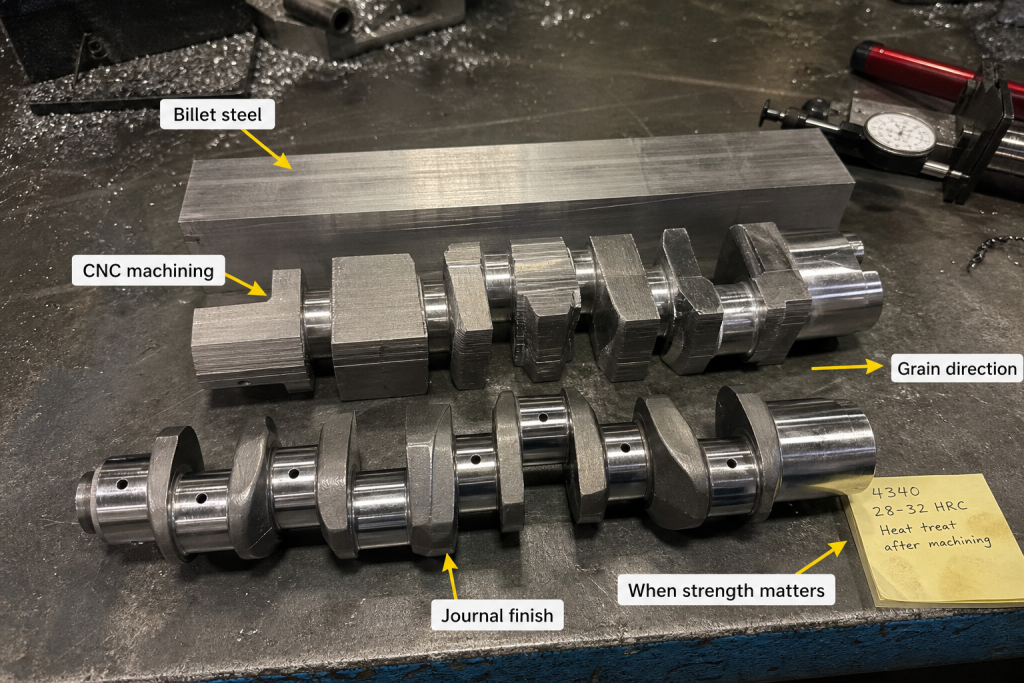
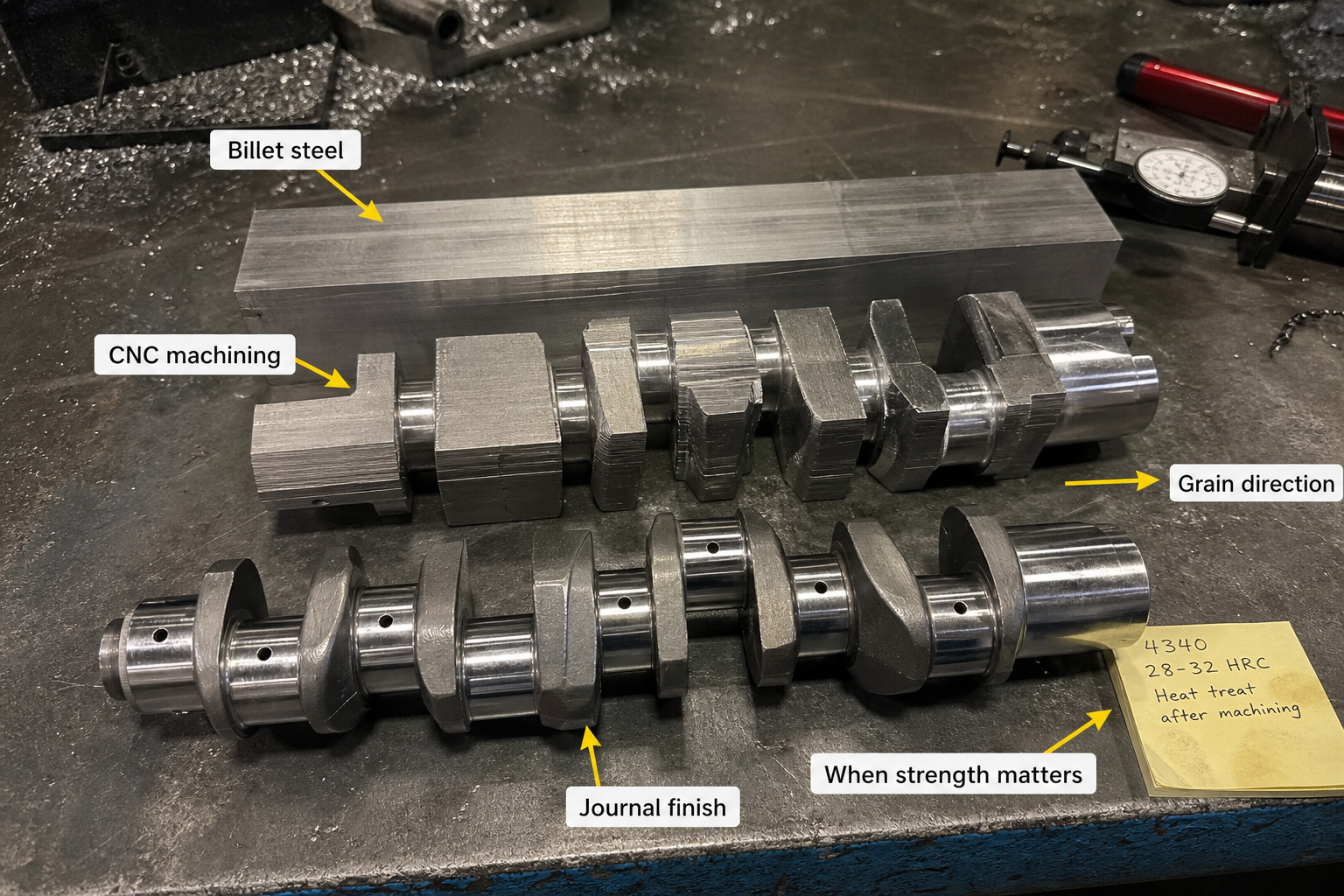
A billet crankshaft is machined from a single piece of solid metal bar stock rather than forged or cast. The entire crank—main journals, rod journals, counterweights, and throws—is cut away from a cylindrical billet on CNC mills and lathes.
This method lets you specify exotic alloys, custom stroke lengths, and journal sizes that no forging die accommodates. Billet cranks appear in one-off race engines, prototype development, and stroker builds where forging tooling does not exist or cannot justify setup cost.
The manufacturing route trades production speed for flexibility. Where a forged crank flows grain structure along stress paths, a billet crank relies on base material strength and machining precision to handle load.
Key Takeaways
- Billet crankshafts are machined from solid bar stock, giving complete control over material choice and dimensions without forging dies.
- Grain flow runs perpendicular to some stress directions, so billet cranks depend on alloy strength rather than directional grain orientation.
- Custom stroke, journal diameter, and counterweight geometry make billet the only practical option for low-volume and prototype applications.
- Material cost, machine time, and setup push billet crank pricing well above forged equivalents in production-volume engines.
- Billet makes sense when no forging exists for your configuration or when material specification overrides cost and lead time.
How Billet Crankshaft Machining Works
The process starts with a cylindrical billet, typically 4340 chromoly steel, 300M, or EN24T alloy bar. The billet diameter must clear the largest counterweight radius plus cutter access. Length equals the overall crank length plus stock for center drilling and parting.
CNC lathes turn the main and rod journals to final diameter and surface finish. Each journal requires multiple roughing and finishing passes with interrupted cuts around counterweights. Rigid setup and tooling prevent deflection that would create taper or out-of-round conditions.
Milling operations cut the counterweights, oil holes, and keyway. Five-axis mills access complex geometry without multiple setups. Drilling oil passages through journals and throws requires precision angle drilling to maintain wall thickness and flow area.
Heat treatment follows rough machining if the alloy requires it. Final grinding of journals, balancing, and nitriding or surface treatment complete the crank.
Billet vs. Forged Crankshaft Grain Structure
Forged crankshafts compress heated billet stock into dies that shape journals and counterweights. The forging process aligns metal grain structure along the crank’s load paths—around journal fillets and through counterweights. This directional grain flow increases fatigue strength where bending and torsional loads concentrate.
Billet machining cuts across the original bar stock grain structure. Grain runs parallel to the crank centerline because that is how bar stock forms. Rod journal throws and fillets see grain running perpendicular to primary bending loads.
The strength difference depends on alloy and heat treatment. A billet crank machined from 300M and properly heat-treated can exceed a forged 4340 crank in ultimate tensile strength. But forged grain flow gives better fatigue life under cyclic loading at equivalent material strength.
This matters in endurance racing and high-cycle-count applications. Sprint racing and dyno development tolerate billet cranks if the material meets peak load requirements.
When Billet Crankshafts Make Sense
Billet becomes the practical choice when forging dies do not exist for your configuration. Stroker cranks with custom throws, non-standard journal spacing, or proprietary counterweight geometry require billet unless production volume justifies die costs in the tens of thousands of dollars.
Prototype and development engines use billet cranks to test stroke lengths, rod ratios, and bearing arrangements before committing to forging tooling. You can machine a revised crank in weeks instead of waiting months for die production and forging runs.
Exotic alloy requirements also push builders toward billet. If your engine needs a maraging steel or proprietary alloy not available in forged blanks, billet lets you source bar stock and machine it. Material traceability and certification come directly from the billet supplier.
Low-volume race series and specialty builds absorb the cost premium because the alternative—custom forging dies—costs more than machining a few dozen billet cranks. If your production run stays under 50 units, billet machining usually costs less than forging setup.
Material Selection for Billet Crankshafts
4340 chromoly steel remains the baseline billet material. It offers good tensile strength, ductility, and availability at reasonable cost. Heat-treated 4340 reaches 180-220 ksi tensile strength depending on temper.
300M alloy adds silicon to 4340 for improved hardenability and toughness. Properly treated 300M reaches 280 ksi tensile strength with better fatigue resistance than 4340. The material costs more and requires careful heat treatment control.
EN24T provides similar properties to 4340 with metric availability. Some European and Asian builders prefer EN24T for local sourcing and established heat treatment procedures.
Maraging steels and exotic nickel alloys appear in extreme applications but require specialized machining and heat treatment. These materials cost several times standard alloy pricing and extend lead times.
The material choice depends on peak cylinder pressure, rod angle, stroke length, and RPM range. Calculate bending stress at the rod journal fillet and compare to material fatigue limits with appropriate safety factor.
Cost and Lead Time Considerations
Billet crankshaft pricing reflects raw material cost, machine time, and setup complexity. Expect to pay two to four times the cost of an equivalent forged crank if a forged option exists.
Material cost scales with billet diameter and length. A stroker crank requiring larger billet stock costs more than a stock-stroke replacement. Exotic alloys multiply base material cost by factors of three to ten.
Machining time depends on journal count, counterweight complexity, and final tolerances. A four-cylinder crank with simple counterweights machines faster than a V8 with complex weight geometry. Tight tolerances on journal diameter, surface finish, and runout add grinding and inspection time.
Lead time runs four to twelve weeks for most builders. Rush orders cost more but can compress schedules when machine time is available. Ordering multiple cranks in a batch reduces per-unit cost through setup amortization.
Billet vs. Forged Decision Matrix
Factor | Choose Billet When | Choose Forged When |
Configuration | Custom stroke, non-standard journals, or prototype geometry | Standard dimensions with available forging |
Production volume | Under 50 units | Over 100 units |
Material | Exotic alloy not available forged | 4340 or common alloys sufficient |
Lead time tolerance | 8-12 weeks acceptable | Need faster production turnaround |
Budget | Cost premium acceptable for flexibility | Production volume justifies forging setup |
Fatigue life | Material strength meets cycle requirements | Maximum fatigue life required |
This matrix assumes single-source ordering. If you already own forging dies, forged production cost drops below billet at any volume.
FAQs
Can you repair or regrind a billet crankshaft?
Yes, if journal wear or damage stays within material limits. Journals can be ground undersize and fitted with undersize bearings like any crankshaft. The lack of grain flow means you lose less fatigue strength per thousandth removed compared to grinding through forged grain structure. Check fillet radius and surface finish after grinding.
Does a billet crankshaft need different balancing procedures?
No, balancing follows the same bob weight calculation and correction drilling as forged cranks. The machined counterweights accept balance holes in any location the machinist specifies. Some builders argue billet counterweights hold balance better because the homogeneous material eliminates forging voids or inclusions.
How do you verify billet crankshaft material certification?
Request mill test reports from the bar stock supplier showing heat number, chemistry analysis, and mechanical properties. The crankshaft manufacturer should provide traceability from billet purchase through machining. This matters for racing series that require material certification or for insurance and liability documentation.
Can billet crankshafts use the same bearings as forged cranks?
Yes, if journal diameters and widths match. Billet cranks machine to any journal size, so you can maintain standard bearing dimensions or specify custom sizes. Oil hole placement and size affect bearing compatibility—verify oil delivery matches bearing design requirements.
Conclusion
A billet crankshaft solves configuration problems that forging cannot address economically. When your build needs custom stroke, non-standard journals, or exotic material, billet machining delivers a usable crank without die investment. The cost and grain structure tradeoffs matter less than getting the right geometry and material for low-volume applications.
Order billet when no forging exists, when prototype development justifies the premium, or when material specification controls your design. For production engines with standard dimensions, forged cranks provide better cost and fatigue life. Match the manufacturing method to your volume, timeline, and engineering requirements rather than following generic preferences.