
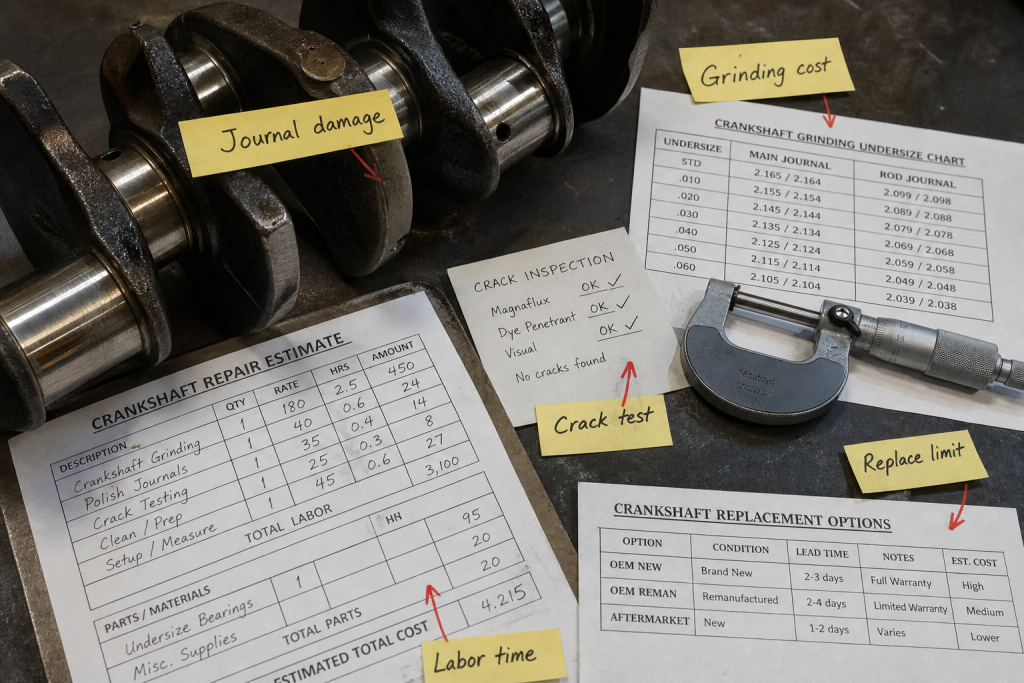
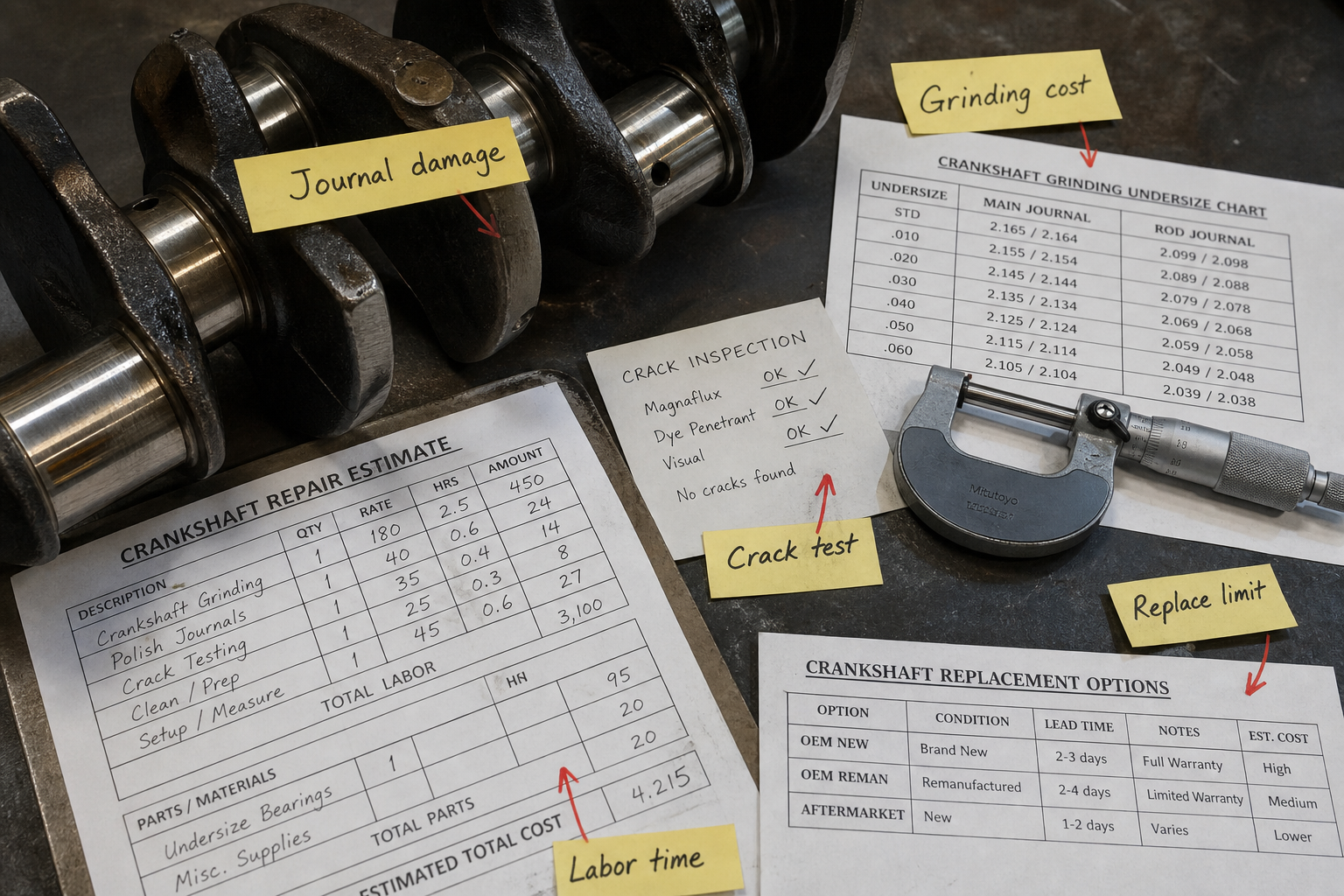
Crankshaft repair costs depend on damage type, required machining operations, and whether the shaft remains within repairable limits. Journal grinding for wear typically runs $200-$600, while welding and regrinding for deeper damage costs $800-$1,500. Line boring for main bearing bores adds $400-$800, and complete rebuilds involving multiple operations can reach $2,500 before balancing and labor.
The decision between repair and replacement turns on remaining journal diameter, crack inspection results, and whether available undersized bearings match the post-machining dimensions. A crankshaft journal worn 0.010" undersize may cost $350 to grind if standard 0.010" bearings exist for that engine. The same shaft with a 0.045" journal step requires welding, grinding, and magnaflux inspection, pushing costs above a remanufactured replacement in many applications.
Key Takeaways
- Standard journal grinding for normal wear costs $200-$600 depending on journal count and shaft size.
- Welding and regrinding for scoring, steps, or out-of-limit journals adds $600-$1,200 to base grinding costs.
- Crankshafts exceeding maximum undersize limits or showing cracks must be replaced; repair is not economical or safe.
- Line boring for main bearing bore misalignment costs $400-$800 and requires block removal and specialized equipment.
- Balancing after machining adds $150-$300 and is mandatory when material removal changes shaft balance.
Assessing Damage Type and Repair Feasibility
Visual inspection identifies three cost-determining damage categories: surface wear, dimensional errors, and structural damage. Measure each main and rod journal with a micrometer at four positions rotated 90° to detect taper, out-of-round, and undersize conditions. Journals worn evenly below original diameter but above minimum specification qualify for standard grinding.
Scoring, steps from bearing failure, or journals already at maximum undersize require weld buildup before regrinding. This process deposits metal via submerged arc or spray welding, then machines the built-up surface back to standard or first undersize. Welding adds 8-12 hours of labor and consumable costs, explaining the $600-$1,200 premium over simple grinding.
Cracks detected by magnetic particle (magnaflux) or dye penetrant inspection disqualify the shaft from repair. Crankshafts operate under cyclic bending and torsional loads that propagate cracks rapidly. No repair process restores structural integrity once a crack initiates in the fillet radius or journal surface.
Machining Operations and Cost Breakdown
Journal grinding is priced per journal or as a complete shaft service. Shops charge $30-$60 per journal for four-cylinder automotive crankshafts, $50-$90 per journal for six-cylinder or larger industrial shafts. A complete four-cylinder shaft with four main and four rod journals costs $240-$480 for grinding to first undersize (0.010").
Grinding to second (0.020") or third (0.030") undersize adds no extra cost if the journals are within limits and require only surface finishing. The price difference appears when journals need multiple grinding passes to remove deep scoring or when pre-grinding measurement reveals mixed undersize conditions requiring different setups.
Operation | Cost Range | When Required |
Journal grinding (per journal) | $30-$90 | Wear, taper, out-of-round within limits |
Complete shaft grinding | $200-$600 | Standard reconditioning |
Weld buildup + grind | $800-$1,500 | Scoring, steps, near-limit journals |
Line boring (block) | $400-$800 | Main bearing bore misalignment |
Balancing | $150-$300 | After any material removal |
Line boring corrects main bearing housing alignment in the engine block after overheating, bearing spin, or block distortion. This operation machines all main bearing bores in a single setup to restore concentricity. The crankshaft is not modified, but the block preparation directly affects crankshaft service life and must be included in total repair cost planning.
Replacement Limits and When Repair Is Not Viable
Each crankshaft design specifies a minimum journal diameter below which bearing oil clearance becomes excessive or bearing availability ends. Automotive crankshafts typically allow 0.030" maximum undersize for main and rod journals. Industrial and marine shafts may permit 0.040" or 0.060" depending on original journal diameter and bearing supply.
A crankshaft measuring 2.240" on a main journal designed for 2.250" standard diameter has 0.010" wear. If the engine uses 0.010" undersize bearings (2.240" journal spec), grinding to 2.230" creates a 0.020" undersize condition requiring different bearings. Check bearing availability before authorizing grinding; some engine models lack 0.020" or 0.030" undersize bearings, making the shaft scrap after first undersize wear.
Runout measured at the center main journal must stay below 0.002" total indicator reading (TIR) for automotive applications, 0.001" for high-speed diesels. Straightening costs $200-$400 but is only effective for runout under 0.006". Crankshafts bent beyond this limit or hardened through induction or nitriding cannot be straightened and must be replaced.
Fillets, oil holes, and thrust surfaces impose additional limits. Grinding removes fillet radius material, reducing fatigue strength. Re-cutting fillets with a radius wheel adds $50-$100 per journal but cannot restore original geometry if grinding has consumed too much fillet stock. Oil hole diameter and position relative to the journal surface must remain within specification to maintain lubrication film pressure.
Cost Comparison: Repair vs. Remanufactured Replacement
A remanufactured crankshaft for a common four-cylinder engine costs $400-$800 with core exchange, $600-$1,200 without core. Industrial crankshafts range from $1,500 to $8,000 depending on size, material, and production volume. Compare total repair cost including removal, machining, balancing, and installation labor against replacement cost plus any block work.
Repair is economical when journals are at standard or first undersize, no welding is required, and the block needs no line boring. A $400 grinding and balancing cost saves $400-$800 against a remanufactured shaft. Repair becomes marginal when welding is required ($1,200-$1,800 total) and replacement shafts are available below $1,000.
For rare, obsolete, or large industrial crankshafts where replacements cost $5,000-$20,000, welding and regrinding at $2,500 total cost remains justified even for heavily damaged journals. Shops specializing in industrial crankshaft repair maintain welding procedures for specific alloys and can build up journals multiple times over the shaft’s service life.
FAQs
Can a crankshaft be repaired if it has a crack in the fillet radius?
No. Cracks in the fillet radius or any journal surface propagate under load and cannot be safely repaired. The crack relief through drilling or stop-drilling does not work on crankshafts because the fillet experiences peak bending stress during operation. Replace any crankshaft showing crack indications after magnaflux or dye penetrant inspection.
How much does crankshaft grinding cost for a six-cylinder diesel engine?
Six-cylinder diesel crankshafts with seven main journals and six rod journals cost $450-$800 for complete grinding to first undersize. Larger journal diameters and longer shaft length increase setup time and grinding wheel consumption. Add $200-$300 for balancing if the engine is not externally balanced.
Does grinding a crankshaft require new bearings even if the old ones look acceptable?
Yes. Grinding changes journal diameter, requiring undersize bearings matched to the post-grinding dimension. Installing standard bearings on an 0.010" undersize journal creates 0.010" excess oil clearance, resulting in low oil pressure and accelerated wear. Always install bearings sized for the actual journal diameter after machining.
What is the maximum number of times a crankshaft can be reground?
This depends on remaining journal diameter relative to minimum specification. A crankshaft allowing 0.030" maximum undersize in 0.010" steps can be ground three times if each regrind removes exactly 0.010". In practice, removing taper and out-of-round may consume 0.012"-0.015" per regrind, limiting most automotive crankshafts to two regrinds before reaching minimum diameter.
Conclusion
Crankshaft repair cost is controlled by damage type, required machining operations, and dimensional limits. Budget $200-$600 for grinding normal wear, $800-$1,500 for welding and regrinding, and $1,500-$2,500 for complete rebuilds including line boring and balancing. Before authorizing repair, confirm that post-grinding journal diameters will remain above minimum specification and that appropriately sized bearings are available. Replace crankshafts showing cracks, excessive runout, or journals at maximum undersize, as repair costs will exceed replacement value or produce an unsafe result.